This page is an English translation of the original Italian article. The original publication date and historical context have been preserved.
Malta is an island worth exploring. History and entertainment make it a memorable destination, but for divers the opportunities multiply beneath the surface, where the seabed holds its own treasures.
Among Malta’s many shore dives, one deserves special attention: the tanker Um El Faroud.
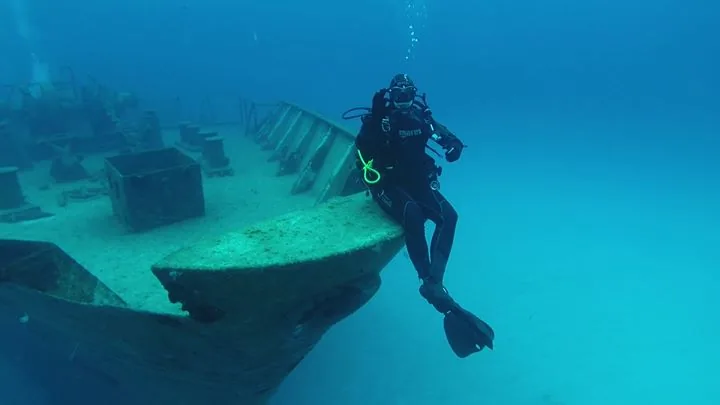
The wreck is approximately 110 metres long, split into two large sections and resting on sand at around 36 metres. It is the kind of site that deserves at least two dives—one for each major section—so that it can be explored without rushing.
From tragedy to artificial reef
Built in 1969, the ship was damaged by a major explosion in 1995. Nine workers lost their lives in the accident. The vessel was left unusable and remained in Valletta harbour for several years before the decision was made to sink it as an artificial reef and diving attraction off Wied iż-Żurrieq.
Reaching the wreck
The site is close to the tourist destination commonly known as Blue Grotto. Divers enter from a concrete ladder at the end of the small harbour, cross the inlet and follow the reef on the right.
At around 15 metres the reef breaks away. The compass is set towards the open water and the swim across the sand begins. Above, the surface is visible through the blue; below, the pale seabed continues with no wreck yet in sight.
The distance feels longer because there is nothing obvious ahead. You simply keep swimming and trust the bearing. Then a dark shape begins to appear and the first detail separates itself from the blue.
The first view
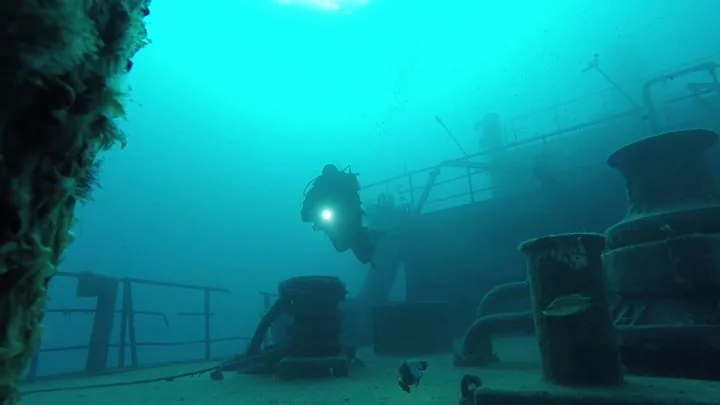
Um El Faroud waits in silence. The white sand makes the wreck stand out, while barracuda often circle nearby as if guarding it.
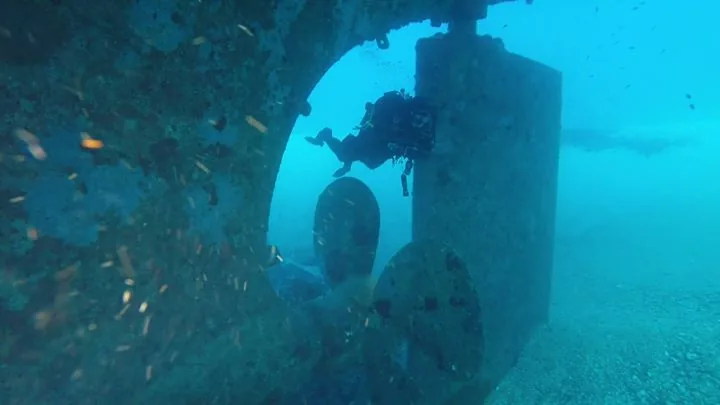
The stern is normally the first major section encountered. The propeller remains in place, providing an impressive starting point. From there the route can continue around the hull, with a torch revealing details through the openings.
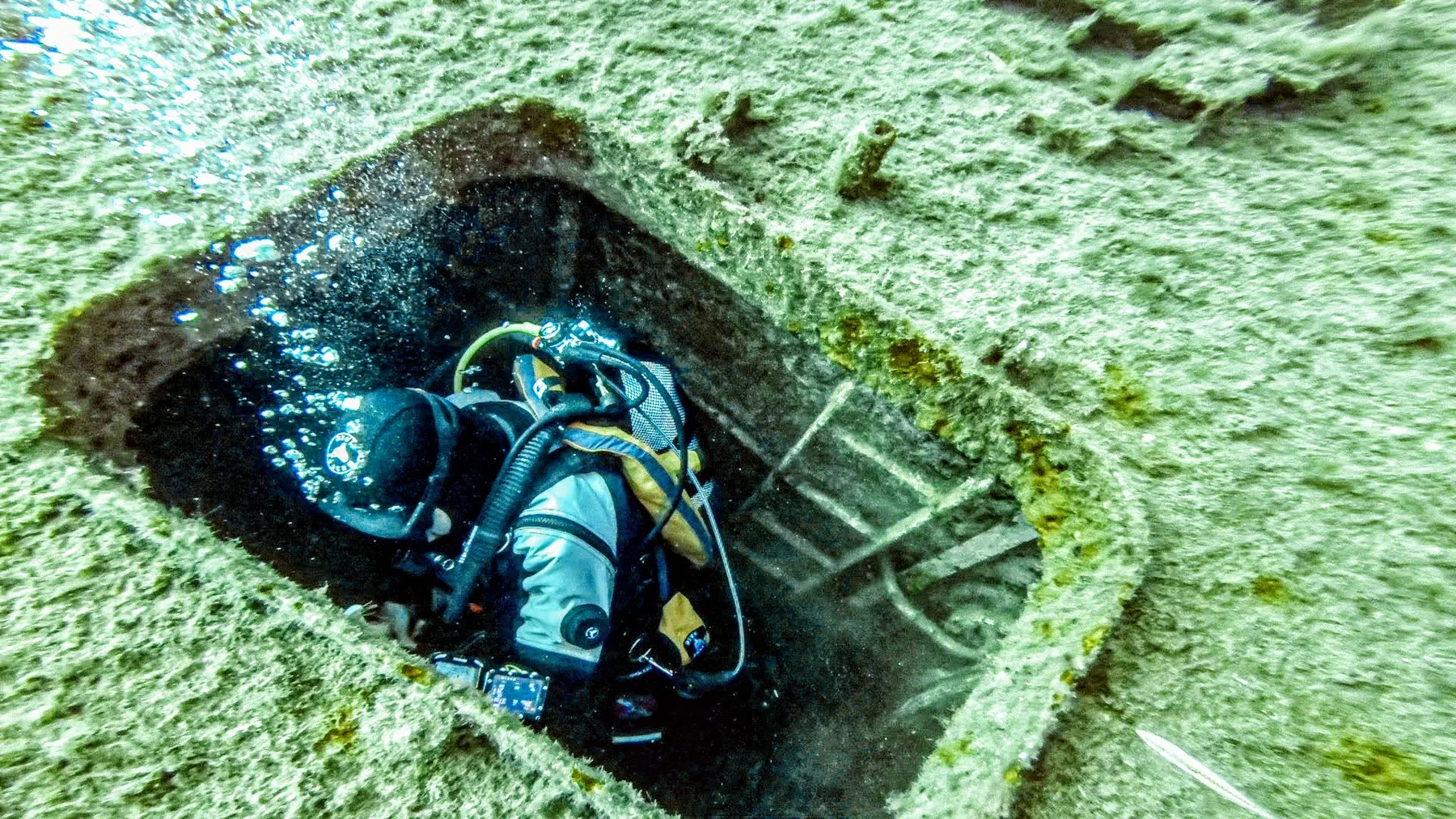
The central break offers views into the structure. Over the years, many hazards such as glass and doors were removed, but wreck penetration still requires the correct certification, equipment, planning and conditions. An apparently open route can become dangerous very quickly inside a large wreck.
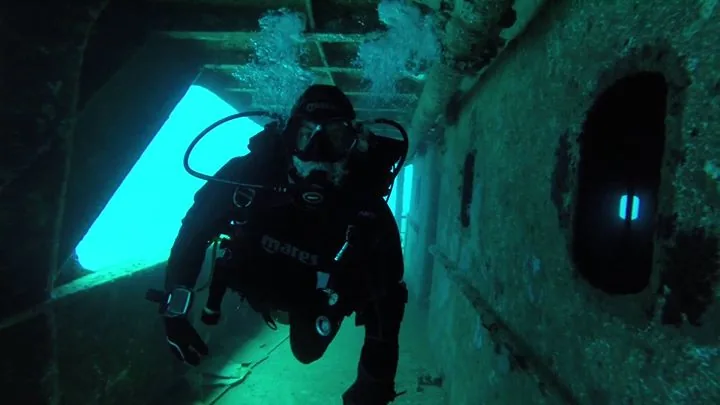
Ascending slightly, divers can explore the superstructure, bridge area and engine exhausts. Light enters through openings, creating a mixture of dark steel and blue water.
Time to leave
Eventually the pressure gauge and dive plan decide the moment to turn. The return along the side deck gives one final view of the ship—window after window leading back towards the open blue.
At roughly 36 metres, bottom time and gas disappear quickly enough that the turn should never be an improvised decision. Put the intended depth, time, gas, RMV and reserve into the planner and cross-check the resulting NDL/decompression and runtime. Build the Um El Faroud profile →
Near the route home is a small monument connected with the organisation that cared for the site, including a traditional diving-helmet motif that often becomes the last photograph of the dive.
The return to shore is not disappointing, because the other half of the wreck remains. After a suitable surface interval, Um El Faroud can be visited again—and the “perfect wreck” reveals another chapter.
Enjoyed this article? If you'd like to help keep the BusaBoy Archive online, you can support the archive via PayPal.