The first five minutes of a student’s dive reveal breathing, buoyancy, trim, awareness and comfort. They provide an instructor with a baseline for the rest of the dive.
The first five minutes of a student’s dive tell me a great deal.
This is not because I expect perfection immediately. In fact, the beginning of a dive is often when a student is still adapting to the water, checking equipment and settling their breathing.
What I am looking for is a baseline. I want to understand how comfortable the diver is today, not how comfortable they appeared during the previous session.
The descent begins the assessment
A controlled descent is one of the first indicators.
Can the student release air gradually, equalise early and remain aware of the team? Do they descend vertically or become unstable? Are they holding their breath, finning downwards or adding too much negative buoyancy?
Whenever possible, a reference such as a line, slope or clearly visible bottom contour gives the student orientation without removing responsibility for buoyancy control.
I also watch whether they protect the environment. A diver who reaches the bottom by landing heavily is not yet neutrally buoyant simply because the descent has stopped.
Breathing reveals comfort
Breathing is one of the clearest windows into a diver’s mental state.
Slow, relaxed breathing usually accompanies better control. Rapid, shallow breaths may indicate stress, physical effort, poor trim, excessive weighting or simply that the diver needs time to settle.
I do not judge gas consumption from the first few minutes alone. Excitement and entry effort can temporarily increase breathing. I am more interested in whether the pattern begins to stabilise.
PADI guidance connects slow, deep breathing with relaxation, more efficient gas use and improved buoyancy control.
A diver’s bubbles also tell a story. Their frequency, volume and rhythm can often be observed before the diver realises that they are breathing too quickly.
Buoyancy, trim and unnecessary movement
Once at the planned depth, I watch how the student establishes neutral buoyancy.
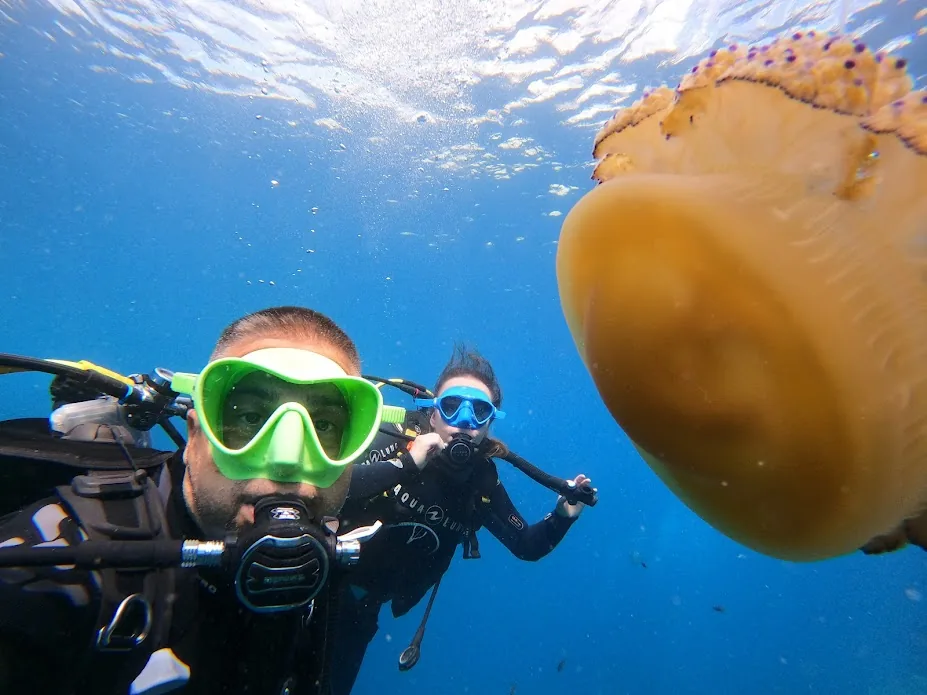
Are they horizontal or standing upright in the water? Are they using small corrections or constantly adding and releasing air? Are their hands relaxed, or are they swimming with them? Do their fins remain clear of the bottom?
A student who can pause, breathe and hover without excessive kicking is beginning to demonstrate real control.
Trim is not about creating a perfect photograph. It affects efficiency, visibility, gas consumption, environmental contact and the ability to respond to another diver.
Monitoring instruments
I also watch whether the student checks depth, gas and the dive computer without being reminded constantly.
Monitoring too infrequently can indicate poor situational awareness. Checking every few seconds may indicate anxiety or a lack of trust in the equipment.
The goal is a natural rhythm.
Dive computers provide information such as depth, no-stop time and ascent rate, while the pressure gauge shows the remaining breathing gas. These tools are useful only when the diver remembers to look at them, understands the display and acts on the information.
Awareness of the team
A student may have good buoyancy and still be unaware of everyone around them.
I look at how often they locate their buddy, whether they respond promptly to signals and whether they maintain a useful position instead of following someone’s fins blindly.
Good diving is not only individual control. It is the ability to function as part of a team.
What I do with those observations
The first five minutes do not determine whether the dive is good or bad. They help me decide what the diver needs.
Perhaps we continue normally. Perhaps I slow the pace, move shallower, adjust a weight, correct a hose, change the route or give the student time to settle before introducing another task.
An instructor who watches carefully can make these changes before a small difficulty becomes a major problem.
The first five minutes are not an examination.
They are a conversation conducted through breathing, movement, positioning and awareness—and I need to listen.