Which one is the best? The answer is: it depends.
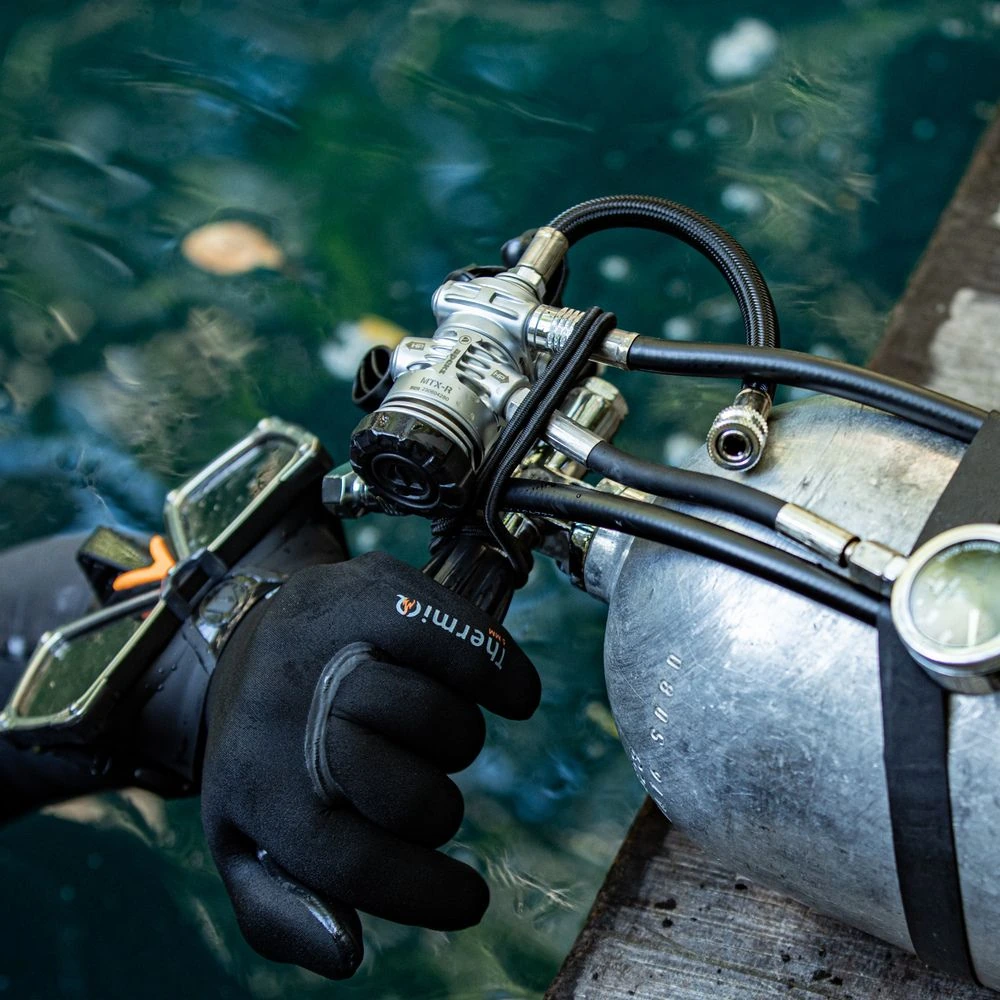
Traditional black rubber hoses and textile-braided hoses—often called “Miflex hoses” after the best-known brand—both do the same essential job: carry breathing gas from the first stage to the second stage. Both can work extremely well. Both also have disadvantages, and neither material removes the need for correct routing, regular inspection and timely replacement.
This comparison is mainly about low-pressure regulator hoses. High-pressure gauge hoses operate under very different loads and should not be treated as the same product simply because the outer covering looks similar.
First, the terminology
“Miflex” is a brand, not the generic name for every flexible hose. The more accurate generic term is textile-braided or polymer-braided hose. Divers sometimes call them embroidered hoses, flex hoses or braided hoses.
Construction also varies. A conventional regulator hose normally combines an inner synthetic-rubber tube, reinforcing layers and a smooth rubber outer cover. Miflex Xtreme hoses use a polyether-based polyurethane inner liner with textile reinforcement and an external braid. Miflex XT-Tech is a different design again: it keeps a polyurethane inner liner and reinforced braid but adds a smooth thermoplastic outer layer, with less flexibility and less tendency to float than the Xtreme version.
The comparison at a glance
| Characteristic | Traditional rubber | Textile-braided / Miflex-style |
|---|---|---|
| Flexibility | Usually firmer and more predictable | Usually very flexible, especially in shorter lengths |
| Weight | Heavier and bulkier | Generally lighter |
| Routing | Tends to stay where it is placed | Easy around tight spaces, but some versions move or float more |
| Surface | Smooth against the neck and exposure suit | Open braid can become rough or frayed; coated versions reduce this |
| External inspection | Cracks, hardening and bulges are often easy to see or feel | Braid shows abrasion, but internal liner degradation may be less obvious |
| Appearance | Traditional, normally black | Many colours and a more modern look |
| Price | Often less expensive | Often more expensive |
Where rubber hoses are strong
Predictable routing
A rubber hose has a useful amount of stiffness and weight. On a standard regulator set, a technical long-hose configuration or any setup where the hose must remain tucked close to the body, that predictability can be an advantage. It bends, but it does not behave like a piece of string.
A smooth exterior
The smooth cover normally slides more comfortably across the neck, drysuit seal or hood. This matters particularly with long hoses routed around the neck. An exposed textile braid can eventually develop rough fibres, especially after repeated contact with rocks, boat decks, storage crates or Velcro.
Damage can be easier to recognise
Ageing rubber commonly shows warning signs such as cracking near the fittings, hardening, cuts, surface deterioration or a localised bulge. These signs are not harmless cosmetic changes; they mean the hose should be removed from service.
Where rubber hoses are weaker
Rubber is normally heavier, thicker and less flexible. A hose that is too long can push or pull the second stage, while one routed through a tight bend can create uncomfortable jaw loading. Cold conditions can also make some traditional rubber hoses feel stiffer, although the exact behaviour depends on the compound and product.
Rubber hoses can also fail internally. If the inner tube leaks into the reinforcing or outer layers, the hose may swell into a long bubble. It can look almost comic—until you remember that it is part of your breathing system.
Where braided hoses are strong
Flexibility and comfort
The main attraction is obvious as soon as you handle one. A quality braided hose can be light and extremely flexible, allowing the second stage to move naturally without pulling at the mouth. Short primary, alternate-air-source, sidemount and inflator-hose routing can feel cleaner when the length has been selected correctly.
Lower bulk and more choice
Braided hoses are available in many lengths and colours. Colour is not a performance feature, but it can help identify a dedicated regulator, stage cylinder or inflator line—and many divers simply prefer the appearance.
Different braided designs solve different problems
Not every braided hose behaves like the very flexible Miflex Xtreme. Miflex describes XT-Tech as a smoother, less-flexible hose aimed at technical and professional divers; it is designed not to be positively buoyant and to reduce abrasion around the neck. Apeks also supplies a nylon-braided hose with its EVX200 and specifically claims better cold-water performance than a traditional rubber hose. Those are product-specific design choices, not proof that every braided hose is superior to every rubber hose.
Where braided hoses are weaker
Too much flexibility can become a routing problem
A very soft hose may not stay neatly behind the head or under a retaining point. Some braided hoses are also slightly buoyant, which can make a long hose or sidemount route move away from the body. The correct length and the exact hose model matter more than the word “braided”.
The outer braid can fray
Repeated rubbing can produce fuzzy fibres or a rough surface. Apart from appearance, this can be irritating against the skin or damaging to a neck seal. A smooth-coated braided hose such as XT-Tech behaves differently from an exposed Xtreme-style braid.
Internal condition is not always visible
DAN has documented cases in which the thermoplastic lining of some low-pressure braided hoses degraded and released debris capable of restricting gas flow or contaminating other low-pressure circuits in a first stage. Material choice matters: DAN’s technical review distinguished hydrolysis-prone polyester-based polyurethane from polyether-based polyurethane, which performed better in accelerated ageing tests. Miflex states that its current Xtreme and XT-Tech hose liners are polyether-based polyurethane.
This does not mean that every braided hose is unsafe, or that rubber never degrades. It means that a nice-looking outer braid is not proof of a healthy inner liner. Use reputable, clearly marked products and take any change in flexibility, airflow or inflation performance seriously.
Do not confuse low-pressure and high-pressure hoses
A past U.S. recall involved specific Miflex high-pressure hoses used with pressure gauges. Other brands of braided high-pressure hoses have also been recalled. Those events should not be used to condemn every braided low-pressure regulator hose, but they are a good reminder to verify the exact manufacturer, pressure class, markings and date—not simply the appearance.
What matters more than the material
- Correct length: neither stretched nor forming unnecessary loops.
- Correct routing: no sharp turns, pinching, snag points or constant rubbing.
- Correct fitting and pressure rating: an LP hose goes only into an LP port.
- Known manufacturer: avoid unmarked hoses and unknown copies.
- Installation: correct threads, clean sealing surfaces and appropriate tightening.
- Storage: rinsed, dried and protected from prolonged heat, sunlight and chemicals.
- Replacement: based on condition, age, usage and manufacturer guidance—not optimism.
Miflex’s own instructions warn against over-flexing, folding a hose back on itself or repeatedly bending it at one fixed point. The specified minimum bend radius is at least 3.5 times the hose’s outside diameter. A flexible hose is still not infinitely flexible.
How I inspect a regulator hose
- Look closely at both end fittings and the crimped areas.
- Run your fingers along the full length, feeling for hard spots, soft spots, flattening, cuts or changes in diameter.
- Check rubber for cracks, perishing or bubbles.
- Check braid for fraying, abrasion, discoloration or exposed inner material.
- Pressurise the regulator and listen for hissing or leakage.
- During the predive check, notice any unusual breathing resistance or slow inflator response.
DAN recommends squeezing hoses along their length to detect changes in resistance or flexibility. A hose that leaks, hisses, swells, feels abnormal or restricts flow is not a “monitor it for later” item. Replace it and investigate the regulator before diving again.
My personal choice
If I have to choose, I normally prefer textile-braided Miflex hoses. I like the appearance, the flexibility and how they have lasted in my own equipment. In normal diving I have not found a dramatic performance difference between a good rubber hose and a good braided one; correct length and routing have made a bigger difference to me.
My most memorable hose problem was actually with rubber. It began leaking internally between its layers, and the outer cover gradually inflated until the hose looked like a sausage. 😄 Funny to describe afterwards, but definitely not something to keep using.
That is my experience and my preference—not a universal test result. Another diver may reasonably choose rubber because it routes better around the neck, costs less or has given years of reliable service. The best hose is the correctly specified, correctly routed and well-maintained one that suits your configuration.
The final answer
Rubber or braided? It depends.
Choose rubber when you want smoothness, predictable routing and traditional simplicity. Choose a reputable braided hose when low weight, flexibility and compact routing are priorities. For technical configurations, consider whether a smoother, less buoyant braided design or a well-routed rubber hose better matches the job.
Whichever you choose, do not judge life-support equipment by colour or fashion. Know what it is made from, inspect it properly and replace it before a small warning becomes an underwater emergency.
Sources and further reading
- Miflex — Scuba-diving hose range and materials
- Miflex — XT-Tech installation, use and inspection instructions
- Divers Alert Network — Air Hoses: A Closer Look
- Divers Alert Network — Hose Failure
- Apeks — EVX200 braided-hose product information
- U.S. CPSC — 2012 recall of specified Miflex high-pressure hoses
Enjoyed this article? If you'd like to help keep the BusaBoy Archive online, you can support the archive via PayPal.