
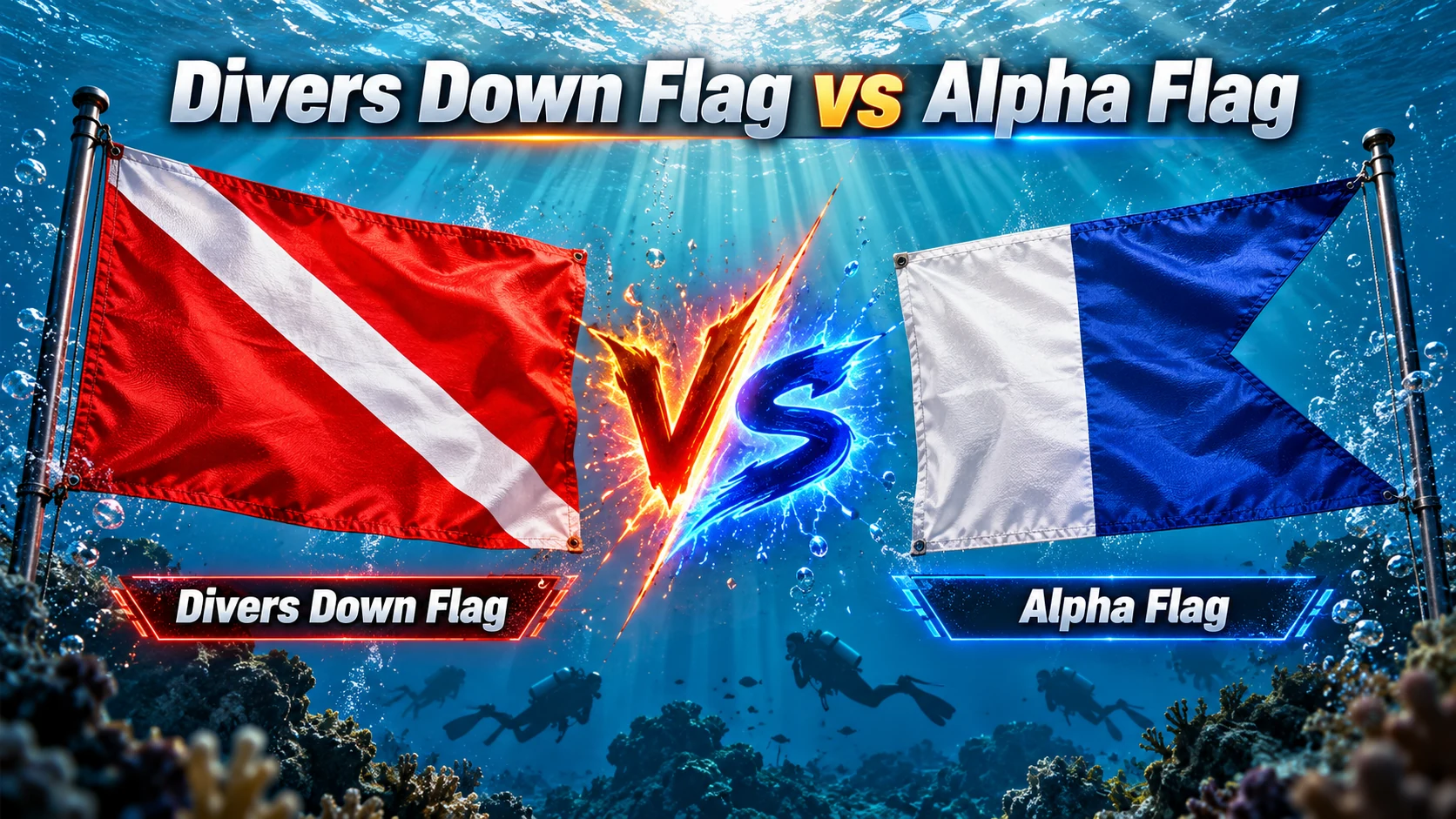
Put the two flags next to each other and it almost looks like a videogame selection screen: red and white in one corner, blue and white in the other. Divers Down Flag versus Alpha Flag.
So which one is the real diving flag? The answer is slightly inconvenient: both are real, but they are not exactly saying the same thing. After enough time around dive boats, shore dives, DSMBs, skippers and busy summer coastlines, you realise that this is one of those subjects many divers recognise visually without necessarily understanding properly. Most know that both flags have something to do with people being underwater. Fewer can explain what each flag is actually communicating to an approaching vessel.
That difference matters, especially in places like Malta where divers, tourist boats, jet skis, fishing vessels and private craft routinely share the same water.
The red-and-white Divers Down flag
The familiar red flag with the white diagonal stripe is probably the image most recreational divers immediately associate with SCUBA diving. Its message is deliberately simple: divers are in the water.
That is why you see it on dive floats, buoys, boats, stickers and dive-centre signs. Divers Alert Network describes it as a signal that explicitly tells boaters divers are in the water, while also reminding divers that the legal requirements for size, distance and use vary by location.
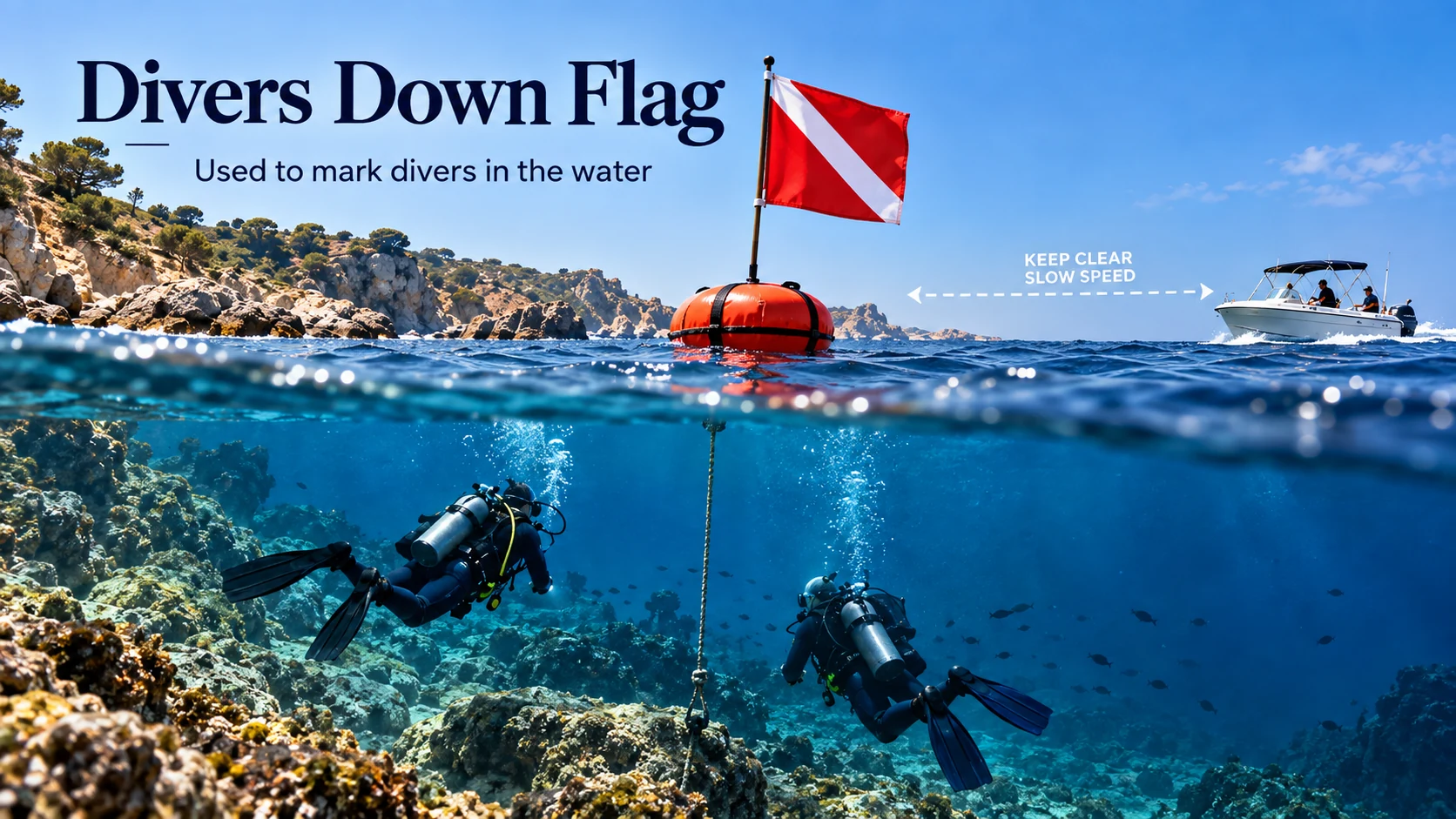
This is the easiest way I remember its role: the red-and-white flag is fundamentally about the diver. If I am shore diving and towing a float, there may be no dive vessel involved at all. The useful information for somebody approaching in a boat is simply that people are underwater around that marker and may surface nearby.
Then we have the Alpha flag
The Alpha flag — International Code of Signals letter A — is white and blue with the characteristic swallow-tail shape. Its internationally recognised message is: “I have a diver down; keep well clear at slow speed.”
The important difference is that Alpha belongs to the language of vessels. It tells other mariners that a vessel is conducting diving operations and cannot be treated like an ordinary boat that can simply manoeuvre away whenever another craft approaches.
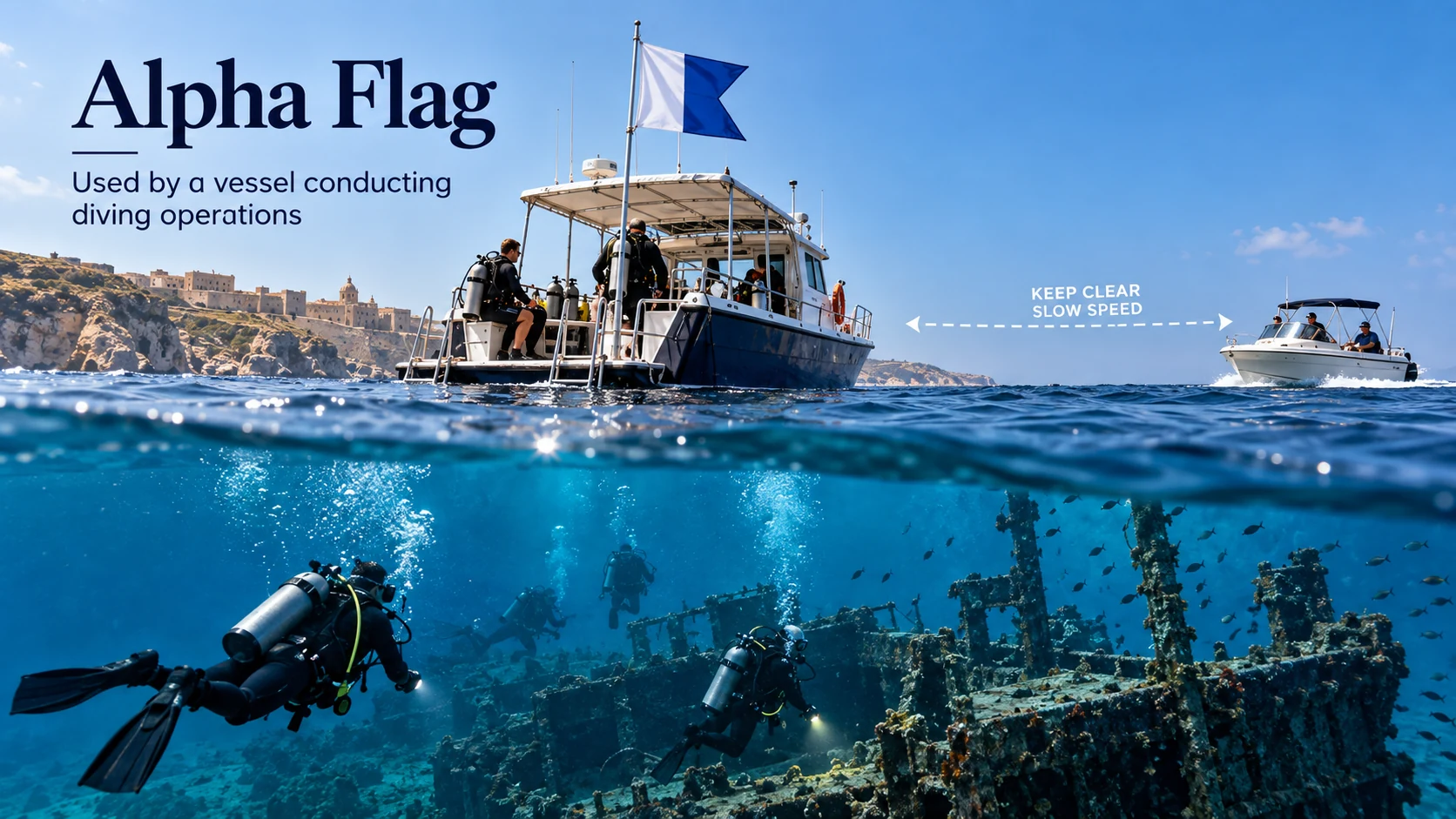
So describing Alpha as “the European diving flag” and the red flag as “the American diving flag” misses the useful part. They developed from different signalling ideas. One very directly marks the presence of divers. The other is an internationally recognised maritime signal associated with the vessel conducting the diving operation.
Practical example #1: a boat anchored over a wreck
Imagine a dive boat anchored over a wreck. Twelve divers are underwater. Some will return to the shot line, others may deploy DSMBs and surface away from the boat. The skipper cannot simply start the engine and drive off because another boat wants to pass close by.
This is exactly where the Alpha flag makes sense. In Malta, the current Transport Malta Local Notice to Mariners No. 069 of 2024 states that vessels carrying out diving operations are to exhibit a rigid replica of International Code flag A, at least one metre high and visible all round. The same notice repeats the meaning: diver down; keep well clear at slow speed.
If the same dive boat also displays the red-and-white Divers Down flag, there is no contradiction. It simply adds another very obvious warning that divers are physically in the water. DAN specifically notes that the two flags can be used together because they communicate related but slightly different information.
Practical example #2: two divers entering from shore
Now remove the boat completely. Two divers enter from a rocky shore and tow a surface float displaying the red-and-white flag. Nothing about a vessel's manoeuvrability needs to be communicated because there is no dive vessel. What matters is that passing traffic understands there are divers below or close to that marker.
This is where the Divers Down flag is immediately intuitive. It marks the presence of divers rather than the operational condition of a boat. The exact legal requirements still depend on location, but the safety logic is universal: if there is boat traffic, make the diving activity obvious before the diver reaches the surface.
What about a DSMB?
A DSMB is another layer, not a replacement for every other signal. When I send one up during an ascent, it tells the surface something extremely useful: there is a diver here, now. But it does not describe the complete diving operation around a boat, and an Alpha flag on the boat cannot tell every skipper exactly where each individual diver will surface.
That is why good surface safety is layered. A dive vessel displays the appropriate signal. Divers use SMBs or DSMBs when required. The skipper keeps a proper lookout. Divers ascend under control and pay attention to traffic. No single flag, buoy or piece of equipment is magic.
The Malta detail worth remembering
There is another reason I wanted to write this article. Divers sometimes repeat an old distance as if it is permanently written into Maltese rules. Transport Malta's older 2023 notice required a berth of not less than 100 metres from vessels or buoys displaying diver signals. That notice is no longer the current one.
The current standing notice is Local Notice to Mariners No. 069 of 2024, which appears in Transport Malta's 2026 cumulative list. It emphasises a proper lookout, safe distance and safe speed, and retains the Alpha-flag requirement for vessels conducting diving operations. The lesson is simple: regulations change, so checking the current notice is better than relying on what someone remembers from years ago.
The worst possible interpretation
The real problem is not a diver confusing the names of the two flags. It is a boat operator seeing either one and treating it as decoration.
A diver at five metres doing a safety stop cannot reliably determine where every engine sound is coming from. Underwater sound travels well, but direction is difficult to judge. Even if I hear a boat, that does not mean I know whether it is passing safely fifty metres away or heading directly over me. At some point I still have to surface.
The person driving the boat has much more ability to prevent the collision: see the signal, reduce speed, increase the distance and keep looking. That is the entire reason these signals exist.
So which flag wins?
For the illustration I deliberately wanted the videogame idea: Divers Down Flag VS Alpha Flag. It creates the question immediately. Which one wins?
Reality is less dramatic. The red-and-white Divers Down flag says, in very direct visual language, divers are here. The Alpha flag says through the international maritime signalling system, I have a diver down; keep well clear at slow speed, and is tied to a vessel conducting the operation.
If I am underwater, I really do not care which flag finally makes the approaching skipper reduce the throttle. Ideally, the skipper recognises both.
Because flags, DSMBs, lights, whistles, procedures and good lookout all serve the same objective: we go diving, and everybody comes back safely.
And for the person driving past us, the practical rule can be made even simpler: if you see either flag around diving activity, slow down, look carefully and give the divers space.
Sources and further reading
- Transport Malta — Local Notice to Mariners No. 069 of 2024: Safe Distance and speed from Diver Flag signals
- Transport Malta — 2026 cumulative list of Local Notices to Mariners
- Divers Alert Network — Safe Boating Guidelines
- International Maritime Organization — COLREG: Preventing collisions at sea