
Listen to the Discussion
Prefer listening? Explore the ideas behind this article in our podcast discussion, or continue reading the full text below.

I have more than 3,600 logged dives, which means I have spent a very large part of my life in or around the sea. I have dived through different seasons, in different countries and conditions, and I have watched the underwater world for many years. Like most divers who have been doing this for a long time, I have memories of unusually warm water, unusually cold seasons, years with more jellyfish, years with fewer fish and occasions when something underwater simply seemed different from what I remembered.
But I want to make an important distinction from the beginning: my experience is not climate data. A diver can notice changes, and a logbook can preserve interesting observations, but neither is enough to establish what is happening to the climate of an entire planet. If I am going to write about global warming, I do not want to begin by telling readers what they are supposed to believe. I would rather begin exactly where I think any scientific discussion should begin: with the measurements.
That is particularly important because climate change has become much more than a scientific subject. It has become political, emotional and sometimes almost tribal. People can arrive at the conversation already convinced either that catastrophe is around the corner or that the entire subject is exaggerated. Neither starting position interests me very much. What interests me is a simpler question: what do we actually know, how do we know it, and what does it mean for the ocean?
Weather is what happens today. Climate is the pattern behind it.
One of the most common problems in discussions about global warming is confusing weather with climate. If Malta has an unusually cold week, somebody will inevitably joke about global warming. If Europe experiences an exceptional heatwave, somebody on the other side will present that single event as absolute proof that the climate has changed. Neither example, by itself, tells us very much.
Climate is not determined by Tuesday afternoon's temperature. It is a statistical pattern observed over long periods and across large areas. There will always be cold days in a warming world, just as there were exceptionally hot days before modern global warming became apparent. Natural variability does not disappear because the long-term average is moving.
This is why the long observational record matters. NASA's global temperature series extends back to 1880 and uses air-temperature observations from more than 25,000 meteorological stations, together with ship- and buoy-based sea-surface measurements and Antarctic research stations. The annual values do not rise in a perfect straight line. Some years are cooler than the one before and some are warmer, but the long-term trend is clear. NASA reports that 2024 remains the hottest year in its record and that the 2025 global surface temperature anomaly was 1.19°C above the 1951–1980 average; NASA also notes that the ten most recent years are the warmest on record. NASA's current indicator and official data are available here.
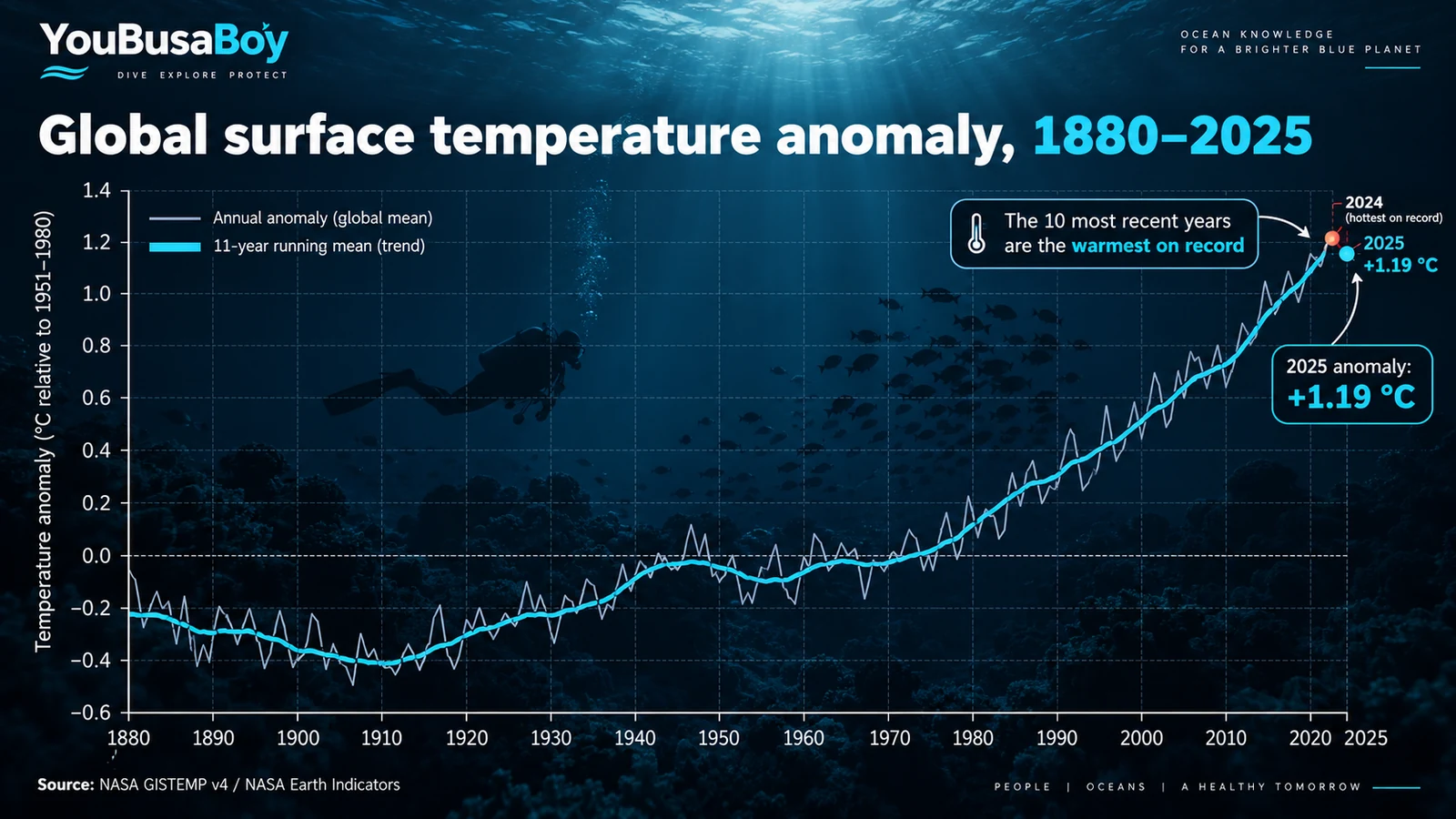
There is an interesting lesson in how those temperature numbers are reported. NASA commonly expresses anomalies relative to the 1951–1980 average, while organisations such as WMO may compare the same recent climate with the 1850–1900 pre-industrial period. The resulting anomaly numbers are therefore different because the reference points are different, not because the organisations are measuring different planets. WMO reports that 2025 was about 1.43°C above the 1850–1900 average and that 2015–2025 were the hottest eleven years in the observational record. Understanding details such as baselines is exactly the sort of thing that makes scientific information more useful than simply repeating a headline.
The climate has always changed. That is not really the question.
It is perfectly correct to say that Earth's climate has changed naturally throughout its history. There have been ice ages, warm periods, volcanic eruptions, variations in solar activity and immense climatic changes long before human beings started burning fossil fuels. I have never understood why that should be treated as a controversial statement, because climate science itself does not deny it.
The real question is whether those natural mechanisms adequately explain the warming we are observing now. That is where the evidence becomes much more specific. The IPCC concludes that human activities, principally through greenhouse-gas emissions, have unequivocally caused global warming. That conclusion is not based on a single thermometer, computer model or institution, but on many independent lines of observational and physical evidence considered together. The IPCC Synthesis Report summarises that evidence.
The basic physics is not particularly exotic. Carbon dioxide, methane and other greenhouse gases interact with outgoing infrared radiation. Increasing their concentration changes the Earth's energy balance, so additional energy accumulates within the climate system. There are many other influences — clouds, aerosols, volcanoes, changes in solar output, land use and natural ocean cycles among them — and scientists spend enormous effort trying to understand those influences as well. The important point is that when all of them are considered together, natural factors alone do not explain the magnitude and pattern of the warming that has occurred.
That does not mean climate science knows everything. It certainly does not. Climate models have uncertainties, regional projections are more difficult than global ones, ecosystems can respond in unexpected ways and precisely predicting what will happen in one particular location several decades from now is much more difficult than identifying the overall direction of global change. Scientific uncertainty, however, does not mean that everything is equally uncertain. We can be uncertain about exactly how strongly one Mediterranean ecosystem will respond while being very confident that the planet and the ocean are warming.
For divers, the most important thermometer may be the ocean itself
When we hear the expression global warming, most of us naturally think about the air. We think about hotter summers, temperature records and heatwaves. Yet the atmosphere is not where most of the additional energy in the climate system has accumulated.
The ocean has taken up the overwhelming majority of it. NASA states that about 90% of the excess heat from planetary warming over the past century has been absorbed by the ocean. NOAA expresses the same point in slightly different terms: more than 90% of the excess heat trapped in the Earth system by human-caused global warming has been taken up by the oceans. This is one of the facts I find most striking because it changes the way we should think about global warming. For somebody who dives, the ocean is not merely being affected by a warming atmosphere; the ocean itself is one of the main places where the additional energy is being stored. NASA's ocean-warming indicator explains the measurements and their uncertainty.
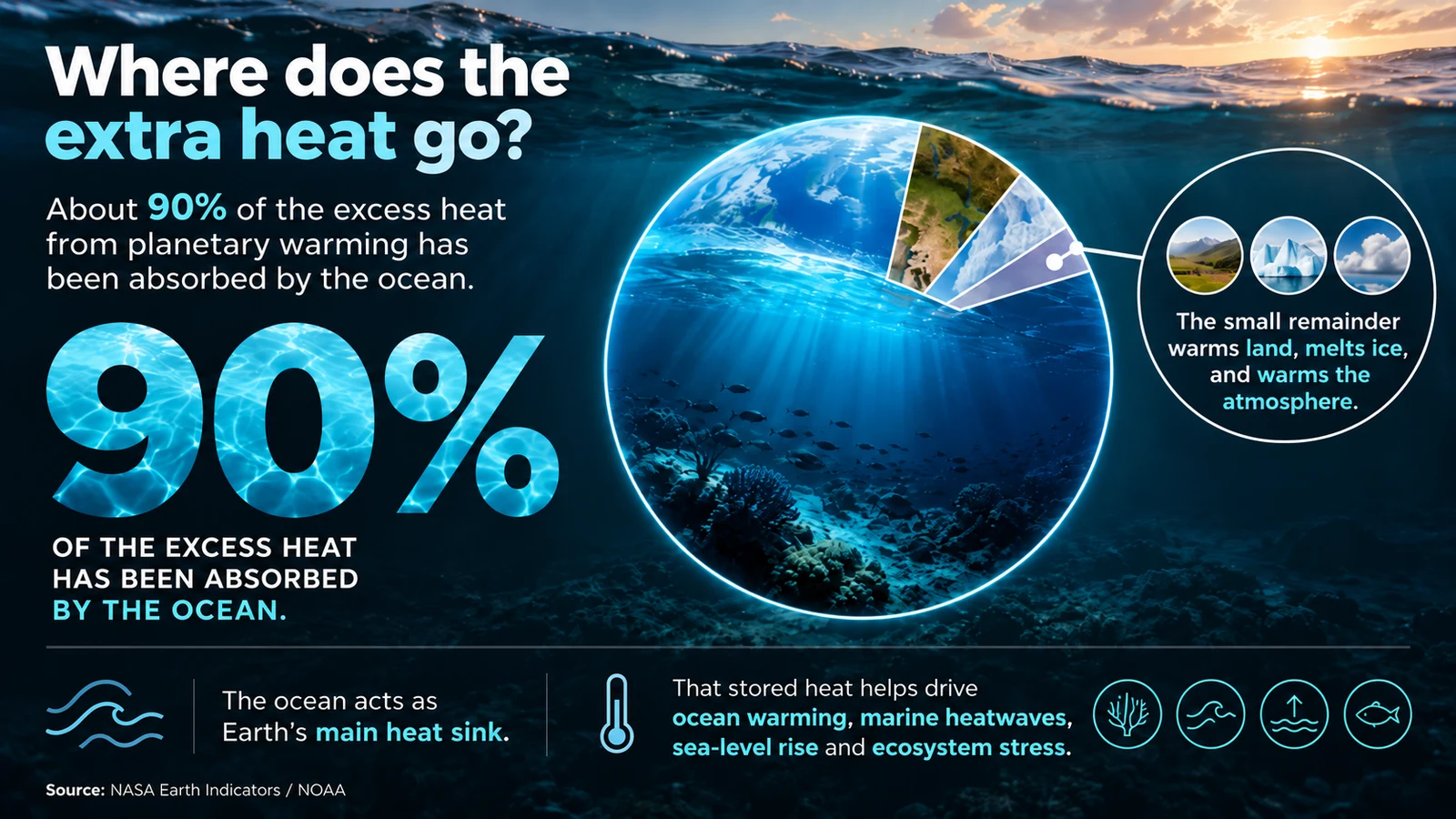
WMO reported that ocean heat content to a depth of 2,000 metres reached the highest level in the 66-year observational record in 2025, and that the rate of ocean warming during 2005–2025 was more than twice that observed during 1960–2005. An ocean can absorb an extraordinary amount of energy because water has a high heat capacity and because heat can be transported into deeper layers. That buffering capacity has slowed the rate at which atmospheric temperatures would otherwise have risen, but the heat does not disappear simply because it is below the surface. WMO's State of the Global Climate 2025 provides the current assessment.
Ocean warming also connects with other changes. Warmer seawater expands, contributing to sea-level rise, while land ice that melts as the planet warms adds still more water to the ocean. Warmer water can generally hold less dissolved oxygen, while stronger stratification can alter the way oxygen and nutrients are mixed through the water column. None of these processes operates in isolation, which is one reason marine ecosystems can respond in complicated ways.
There is another process that is frequently mentioned alongside global warming but deserves to be distinguished from temperature itself: ocean acidification. The ocean absorbs carbon dioxide from the atmosphere, and some of that CO₂ reacts with seawater and changes its chemistry. NOAA reports that average surface-ocean pH has fallen by about 0.1 units since the Industrial Revolution. Because the pH scale is logarithmic, that represents roughly a 30% increase in acidity, although seawater remains alkaline rather than literally becoming acidic. The important biological consequence is the change in carbonate chemistry, which can make life more difficult for organisms that use calcium carbonate to construct shells and skeletons. NOAA explains the chemistry in detail.
The Mediterranean makes this much closer to home
For somebody living and diving in Malta, the Mediterranean makes global climate change considerably less abstract. MedECC, the Mediterranean Experts on Climate and Environmental Change, reports that satellite observations since the 1980s show Mediterranean sea-surface warming of approximately 0.29°C to 0.44°C per decade, depending on the area, with particularly strong warming in parts of the eastern Mediterranean. The same assessment found that over the previous two decades the average frequency of Mediterranean marine heatwaves increased by around 40%, while their duration increased by around 15%. Those figures come from the MedECC Mediterranean coastal-risk assessment.
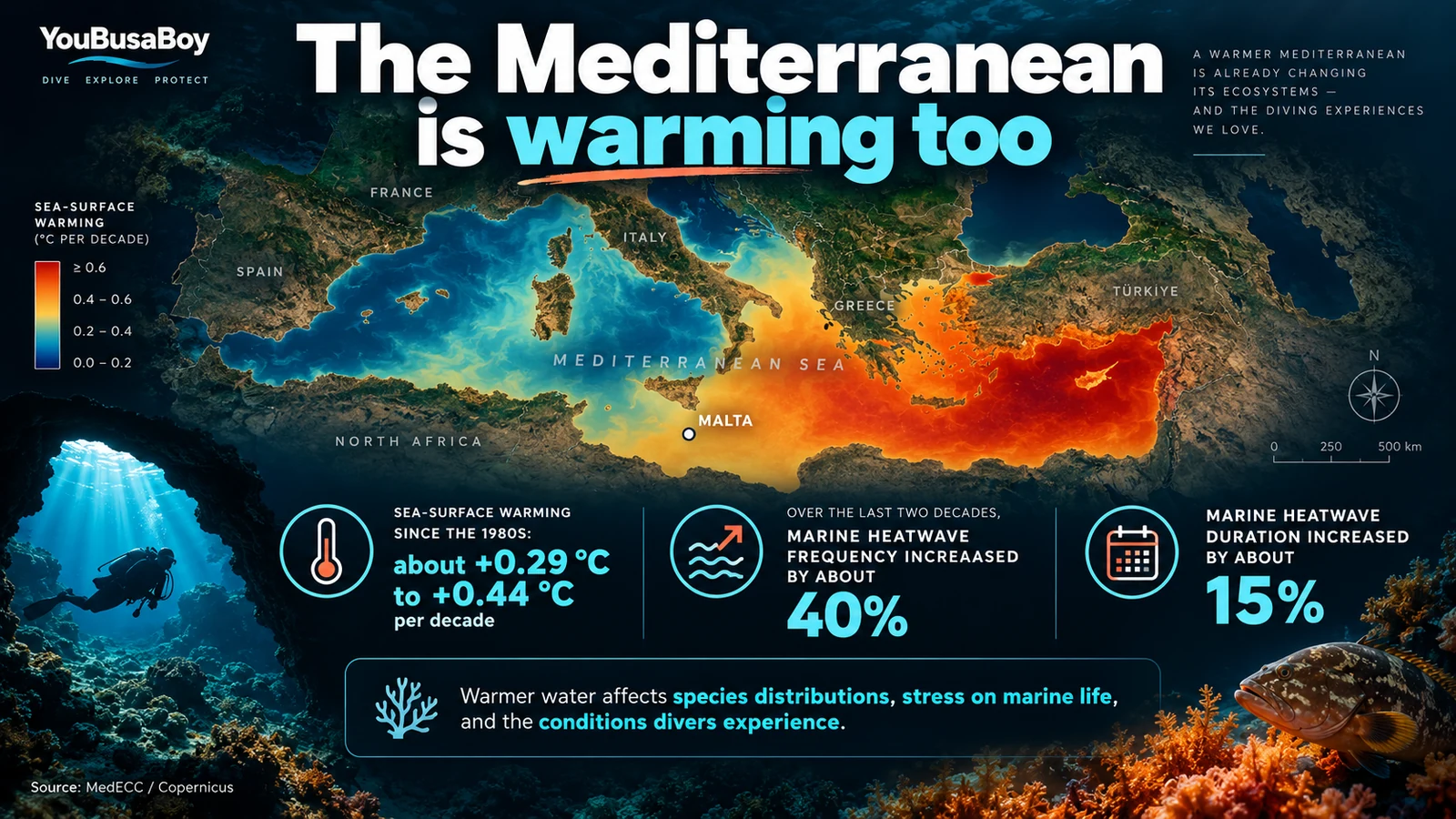
Marine heatwaves are worth understanding because they are more than simply “warm water”. They describe periods when sea temperatures remain unusually high compared with what is normal for that place and time of year. Like heatwaves on land, their biological importance depends on how intense they are, how long they last and how accustomed local organisms are to those conditions.
Recent Mediterranean observations are remarkable. Copernicus reports that every part of the Mediterranean has experienced at least one day of marine-heatwave conditions in each year since 2022, and that the entire sea experienced at least “strong” marine-heatwave conditions in each of the last three years covered by its 2025 assessment. In 2025, just over half of the Mediterranean — 51% — experienced severe or extreme conditions at some point during the year. The Mediterranean's annual sea-surface temperature in 2025 was the second highest in the record, behind 2024. Copernicus publishes the full analysis and its underlying methodology.
This does not mean that every dive in the Mediterranean is now warmer than every dive twenty years ago. Local temperature depends on season, depth, currents, wind, upwelling and many other factors. It also does not mean that seeing one dead sponge or unusual fish proves climate change. That would be exactly the kind of conclusion I am arguing against. What it does mean is that the environmental background against which all those local processes operate is changing, and we now have decades of measurements showing the direction of that change.
What does this actually mean underwater?
Marine organisms are not passive decorations in the water. Every species evolved within particular ranges of temperature, oxygen concentration, acidity, salinity, food availability and seasonal timing. Some species tolerate broad changes; others function within much narrower limits. When conditions shift, ecosystems do not all respond in the same way.
Warmer conditions can alter where species are able to live, when they reproduce and which organisms compete successfully in a particular habitat. In the Mediterranean, warming can favour species adapted to warmer water and can help some species arriving from warmer regions establish themselves more successfully. It would be far too simplistic to say that global warming “causes invasive species”, because organisms arrive through many pathways, including shipping, aquaculture and migration through the Suez Canal. What warming can do is change the environmental conditions that determine whether some newcomers survive, reproduce and spread.
There are also organisms that cannot simply move somewhere cooler. Mediterranean benthic communities include corals, sponges, molluscs, bryozoans and other relatively immobile species, some of which have suffered mass-mortality events associated with extreme temperatures and disease. MedECC identifies marine heatwaves among the pressures affecting these communities and notes that repeated extreme events can push organisms closer to or beyond their thermal tolerance.
This is where I think divers can have a useful perspective, provided we remain disciplined about the difference between observation and evidence. We spend time underwater. We photograph things, record temperatures, log sites and sometimes return to exactly the same reef, wreck or coastline for years. Those observations can make us curious and can occasionally contribute to organised citizen-science projects, but our role should not be to see one unusual event and immediately diagnose the entire ecosystem. Our role can be to notice, document and then ask better questions. That same respect for the environment is behind my older article Underwater, Don't Touch Anything, and it is also why conservation work such as Sharklab's protection of sharks, rays, skates and chimaeras in Malta and the Mediterranean matters even when climate change is not the only pressure involved.
Question climate science. But question it properly.
This article follows naturally from something I wrote recently about diving education and the importance of questioning what we are taught. In SCUBA Diving Is Not a Religion — Stop Teaching It Like One, my argument was that knowledge should remain open to investigation, verification and improvement. I do not want to make an exception simply because the subject is climate change. If anything, a subject this important deserves more questioning, not less.
Ask how global temperatures are measured and how stations with changing locations or instruments are handled. Ask why NASA and WMO sometimes report different anomaly values. Ask how scientists estimate ocean heat when nobody has placed a thermometer in every cubic metre of seawater. Ask how volcanic activity, solar variability, El Niño and other natural processes are separated from longer-term trends. Ask what climate models have predicted well and where they have performed less well. Those are legitimate scientific questions.
But questioning science has another requirement that is sometimes forgotten: we have to be willing to accept an answer when the evidence supports one. Critical thinking cannot mean keeping every hypothesis equally alive forever, regardless of how much evidence accumulates against it. The scientific method is sceptical, but it is not paralysed. That is why the IPCC's use of the word unequivocal matters. It does not mean that every detail of future climate is known; it means that the evidence linking human influence to the observed warming of the atmosphere, ocean and land has become sufficiently strong that the broad conclusion is no longer scientifically ambiguous.
I think this is an important distinction because environmental discussions can become almost religious in the very way I criticised in that previous article. One side may treat every question as denial, while the other may reject evidence simply because accepting it appears to mean joining a political camp. Neither approach is particularly scientific. I do not have to agree with every environmental campaign to accept measurements of ocean heat content, and I do not have to support every proposed climate policy to understand greenhouse physics. Equally, somebody exaggerating one environmental claim does not invalidate thousands of independent observations collected around the world. The evidence should stand or fall on the evidence.
Why I care
My concern for the environment does not begin with politics. It begins with the sea. Diving has given me an extraordinary amount throughout my life: experiences, friendships, work, curiosity, challenges and thousands of hours in a world that most people only see from the surface. That creates an emotional reason for me to care about what happens to it, but I do not want to confuse that emotion with evidence. My attachment to the sea does not prove global warming; the measurements do that job much better than I ever could.
At the same time, recognising climate change does not mean pretending that it is the only environmental problem the ocean faces. Pollution, overfishing, habitat destruction, coastal development, anchoring damage and invasive species continue to put pressure on marine ecosystems. Climate change interacts with many of those pressures rather than replacing them. Protecting a seagrass meadow will not stop global warming, just as picking up a plastic bottle during a dive will not reduce global ocean heat content, but reducing pressures we can control may leave marine ecosystems better able to cope with pressures that are much harder to control locally.
I also do not think environmental concern needs constant catastrophe to remain meaningful. We should not exaggerate what is happening, and we should resist the temptation to attribute every unusual event underwater to one convenient cause. If the evidence is strong, it does not need decoration. The planet is warming, the ocean is storing most of the additional heat, Mediterranean waters are warming and marine heatwaves have become more frequent and persistent. Ocean chemistry is changing as it absorbs more carbon dioxide, and marine ecosystems are responding to a collection of pressures that increasingly includes climate change.
There are still uncertainties about exactly how particular ecosystems will respond, how quickly some changes will occur and which adaptations will prove most successful. That uncertainty is part of science, not evidence that nothing is known. In diving we live with the same principle all the time: recognising uncertainty should make us more thoughtful about the information we have, not persuade us to ignore it.
Perhaps this is ultimately why I wanted to write this article. I have written a lot on YouBusaBoy about equipment, training, decompression, safety and what years of diving have taught me, yet I had never really stopped to write about one of the largest changes affecting the environment in which all of that diving takes place. My earlier article Environment: the “Jellyfication” touched one environmental theme, but this is the first time I have tried to look directly at global warming itself and connect the global evidence with the sea I actually dive.
For me, caring about the environment begins with something very simple. It means paying attention to what is happening, trying to understand what we can actually measure, protecting what we reasonably can, and being willing to change our understanding when better evidence appears. It also means continuing to ask questions, including uncomfortable questions about conclusions with which we already agree. The ocean has given many of us a lifetime of extraordinary experiences. Paying attention to what is happening to it seems like the least we can do.
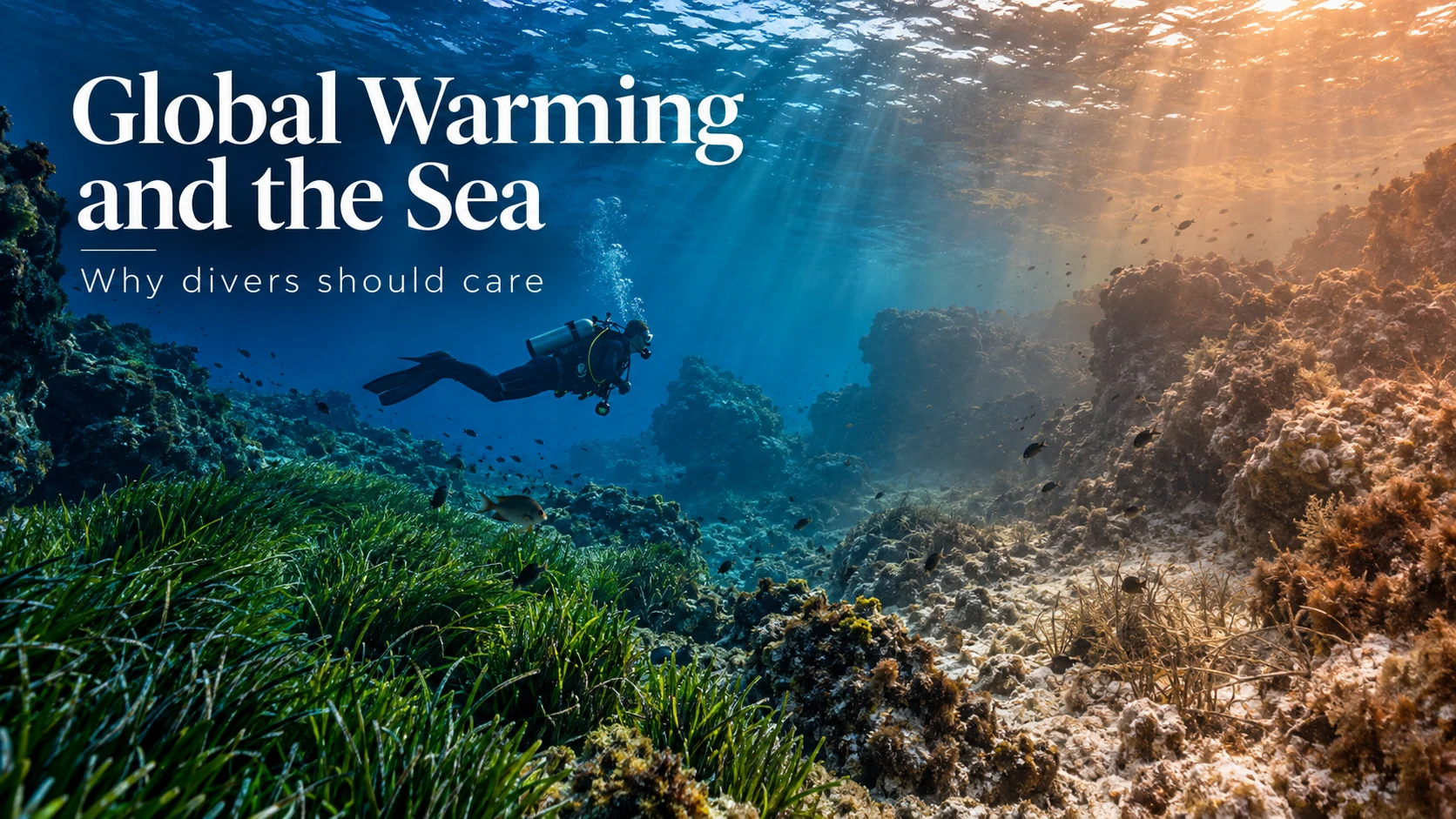
About the visuals: the hero image and infographic backgrounds are editorial illustrations created for YouBusaBoy. They are not documentary before-and-after photographs and are not presented as scientific measurements. The numerical claims and trend statements in the article are linked to their original scientific and institutional sources.
References and Further Reading
- IPCC — Climate Change 2023: Synthesis Report. Human influence, observed warming and climate-system changes. Summary for Policymakers.
- NASA/GISS — Global Temperature Earth Indicator and GISTEMP v4. Global surface-temperature record and the 2025 anomaly relative to 1951–1980. NASA Global Temperature · GISTEMP v4.
- NASA — Ocean Warming Earth Indicator. Ocean heat content and the ocean's role in absorbing about 90% of excess heat from planetary warming. NASA Ocean Warming.
- World Meteorological Organization — State of the Global Climate 2025. Current global temperature, ocean heat content and Earth energy imbalance. WMO report.
- MedECC — Climate and Environmental Coastal Risks in the Mediterranean. Mediterranean sea-surface warming and marine-heatwave trends. Summary for Policymakers.
- Copernicus Climate Change Service — European State of the Climate 2025: Ocean. Mediterranean SST and marine-heatwave extent and intensity. Ocean assessment.
- NOAA — Ocean Acidification. Surface-ocean pH change and the underlying carbonate chemistry. NOAA educational resource.