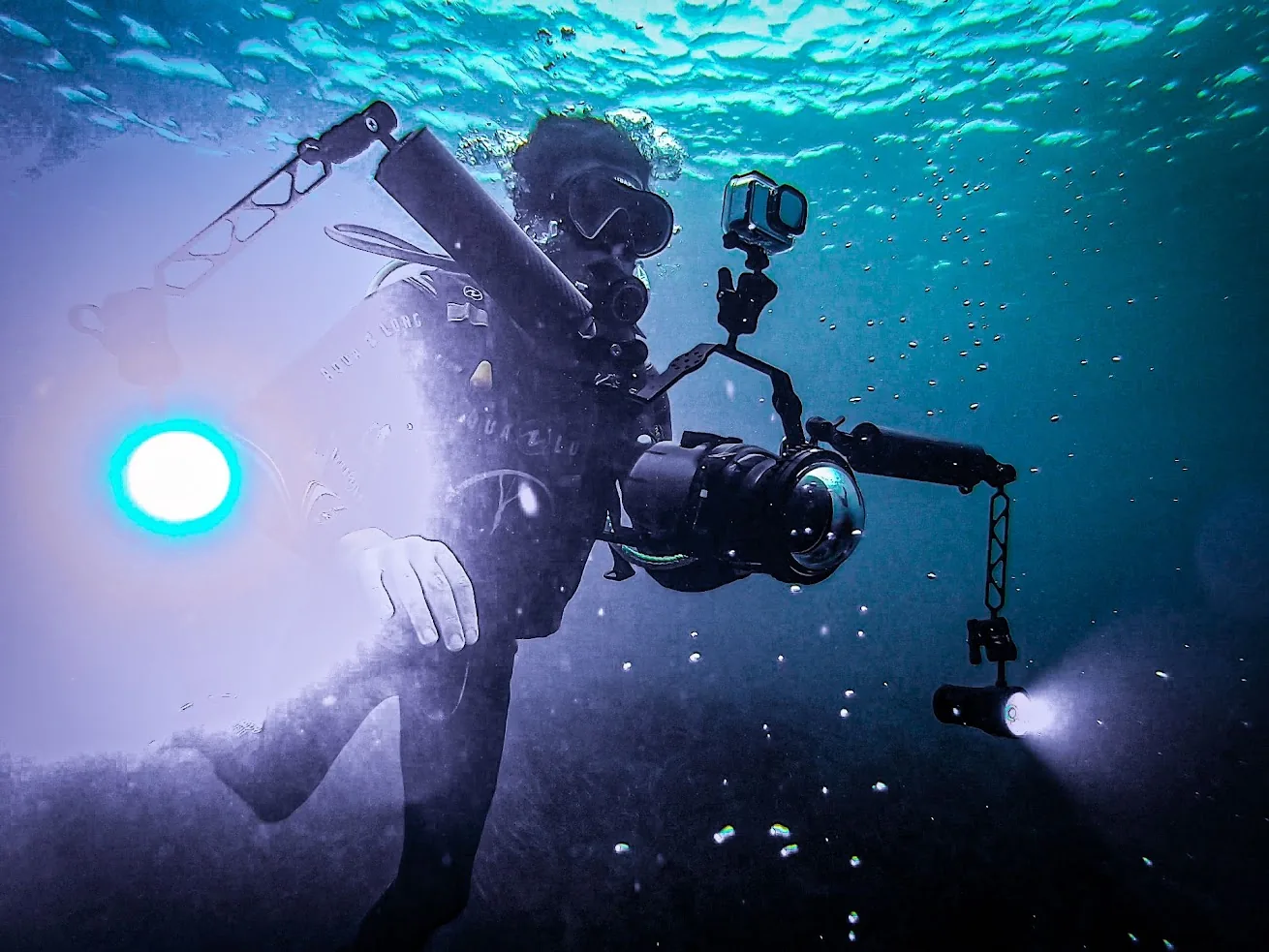
Which torch is the best? The answer is: it depends.
We all know how handy, important and enjoyable a good torch can be. It restores colour, reveals details inside a wreck, helps us read instruments and turns a familiar site into a different world at night. But once a dive moves into technical territory, the torch stops being merely a useful accessory.
It becomes part of a system: a tool for communication, navigation, team awareness and redundancy. In an overhead environment it can become part of the diver’s survival strategy. That is where recreational freedom begins to give way to rules.
The real change is not simply more light
A recreational diver may choose a torch because it is compact, attractive, bright or easy to operate. Those qualities still matter in technical diving, but they are no longer enough. A technical diver must also ask:
- Does the beam produce a clear hotspot for signalling?
- Is the verified burn time suitable for the full dive, including delays and exit time?
- Can it be deployed and operated while wearing gloves and managing other equipment?
- Where is it mounted, and can it be reached without changing trim?
- What happens when it fails?
- Does every member of the team use and understand the same light signals?
The important word is system. A powerful torch used without a plan is not a technical-lighting system.
From recreational freedom to technical rules
A technical light is only one part of the system. Once depth, gas and decompression become part of the dive, the profile should be planned and cross-checked as carefully as the equipment. Build and cross-check the dive in the BusaBoy Dive Planner →
| Question | Recreational use | Technical / overhead use |
|---|---|---|
| Main purpose | Seeing, restoring colour, inspecting and enjoying the dive | Seeing plus communication, navigation, team positioning and emergency management |
| Choice of beam | Flood, adjustable or spot according to preference | A defined hotspot is usually important for signalling; flood lights are normally separate photo/video tools |
| Redundancy | A backup is strongly advisable for night diving | Planned according to the environment; cave diving commonly requires a primary and two backups |
| Mounting | Handheld, lanyard, pocket or wrist mount | Streamlined, repeatable and reachable; a Goodman-style handle is common for the primary |
| Operation | Modes and controls may be chosen for convenience | Simple, predictable operation with no surprise mode cycling |
| Failure response | Switch to the backup and normally end the night dive | Follow the team procedure, deploy the correct backup and begin the appropriate exit or abort |
Night-diving training is an important foundation
A night-diving specialty is not a technical-diving qualification, but it teaches habits that become even more important later: carrying a primary and backup light, navigating in darkness, communicating with a beam, avoiding glare in a buddy’s eyes and managing the psychological change created by limited visual information.
PADI’s public dive-light guidance distinguishes primary and backup lights and specifically recommends a backup for night diving. Its Night Diver course introduces divers to different lights and the procedures needed to dive after dark. Those skills are a sensible foundation before adding decompression, multiple cylinders, overhead restrictions or long exits.
What the major systems say
PADI TecRec
PADI describes TecRec as a transition into specialised equipment, staged decompression, greater task loading and the management of risks beyond recreational limits. The public course pages do not present one universal torch count for every TecRec dive, because an open-water decompression dive is not the same as a cave penetration. The correct configuration depends on the course, environment and instructor standards.
The useful principle is that a technical diver plans equipment around foreseeable failures. A torch carried for communication on a deep open-water dive may require a different level of redundancy from a torch that is the only source of visibility inside a wreck or cave.
TDI
TDI’s published standards show how the requirements increase with the consequences of darkness. Its Cavern Diver standard requires two battery-powered lights with suitable burn time. Its Full Cave Diver standard requires three: one primary and two backups. The courses also include light signals, simulated primary-light failures and exits using the backup.
That progression explains the philosophy very clearly: the deeper the commitment to an overhead environment, the less acceptable it becomes to depend on one light.
GUE
GUE publishes a standardised base configuration. Where lights are required, its standard calls for a rechargeable primary light with a Goodman-style handle. If burn-time needs require an external battery, the canister is placed on the right hip. Backup lights are stowed from the chest D-rings, have minimal protrusions and a single rear attachment; the published standard specifies alkaline rather than rechargeable batteries for those backups.
Whether or not a diver adopts every detail, the logic is valuable: predictable placement, a hands-free primary, simple backups and equipment that every team member understands.
DIR
DIR—Doing It Right—is a philosophy, not a torch model or a badge printed on the box. It is associated with standardisation, simplicity, team awareness and removing unnecessary complications. The classic DIR-style lighting arrangement—a Goodman-handled primary and streamlined twist-on backups clipped high on the harness—is reflected strongly in GUE’s published configuration.
A diver does not become “technical” by buying a twist torch. The important part is understanding why it is selected, where it is stored, how it is checked and what the team does when it fails.
Primary, backup and video lights are different tools
The primary light
The primary is expected to run throughout the working portion of the dive. It needs a beam suited to the environment, sufficient tested burn time and an ergonomic way to keep the hand available. A Goodman handle allows the diver to use fingers for reels, valves, scooters or communication while keeping the beam under control.
A canister is still useful when the dive requires more battery capacity or better distribution of weight, but modern self-contained lights can also provide long burn times. The form factor is less important than verified performance and team suitability.
Backup lights
A backup is not a smaller toy carried to satisfy a checklist. It must be reachable, charged or fitted with known batteries, operable by touch and capable of supporting the planned exit. It should be protected from accidental activation while remaining simple to deploy.
Technical divers practise finding and switching on backups without looking. In a real failure, familiarity is more valuable than an impressive specification sheet.
Photo and video lights
Wide, even illumination is excellent for a camera and often poor for team signalling. A video light can wash out the narrow hotspots used by other divers and may have a shorter high-power burn time. Treat imaging lights as additional equipment, not automatically as replacements for the team’s primary and backup torches.
Beam quality matters more than the biggest lumen number
Lumens describe total light output. They do not tell you how tightly the light is concentrated. A modest torch with a narrow, clean hotspot can be easier to see across a cave passage or through suspended particles than a much higher-lumen flood light.
For technical use, compare:
- Beam angle and hotspot: can the team read the signal clearly?
- Useful spill: is there enough peripheral light to move comfortably without destroying contrast?
- Sustained output: does the torch hold its brightness, or quote only an initial turbo figure?
- Burn time: measured at the intended power setting and with the actual battery.
- Thermal regulation: some high-output lights reduce power as they heat.
- Colour and water conditions: a beam that looks impressive in air may behave differently in silt or plankton.
One LED or several?
I personally prefer simple single-emitter torches for a narrow technical beam. I am also sceptical when a manufacturer advertises a huge number by merely adding the theoretical maximum of several LEDs.
However, multiple LEDs are not automatically dishonest or unreliable. They can produce an excellent smooth flood for video or a useful adjustable beam. The fair comparison is measured light leaving the torch, sustained output, beam pattern and runtime—not the number of emitters alone. More components can add complexity, but the quality of the design matters more than simply counting LEDs.
Buttons, magnetic switches and twist activation
I sell recreational and technical torches, and I often see a misunderstanding here. A simple twist-on backup light can be robust because it removes external buttons and complicated controls. But a torch does not become technical simply because it has no button.
Push buttons, rotary switches and magnetic controls can all be reliable when properly designed. Some do not penetrate the pressure housing at all. A twist light also has threads, sealing surfaces and O-rings that must be clean and used as intended.
The common misuse I see
Some non-technical divers buy a twist-activated light because it looks “technical”, then repeatedly loosen and tighten it underwater to play with the beam. Depending on the design, that movement may drag grit across the O-ring, disturb a sealing surface or move the head farther than intended. The risk becomes worse when the user does not know exactly where the sealed operating range ends and the battery compartment begins.
Some twist lights are specifically designed to be switched while submerged. Others should be prepared before entering the water or operated only within a defined range. The correct rule is simple: follow the manufacturer’s instructions for that exact model. Never unscrew a torch far enough to expose the seal or open the battery compartment underwater.
The problem is not the absence or presence of a button. It is improper use of a piece of equipment chosen for its appearance rather than its operating logic.
The opposite mistake: trusting an unknown cheap torch in darkness
Low price does not automatically mean poor quality, but an untested torch with unrealistic output claims, unknown cells, weak threads, no spare O-rings and no verified burn time should not be the only light between a diver and darkness.
For a technical dive, test the complete unit. Charge it correctly, inspect the seals, run it in water, record the actual burn time and repeat the test as the battery ages. Build reserve into the plan. A label saying “four hours” is not the same as knowing how your own light behaves after repeated use.
A practical selection checklist
- Define the dive: daylight open water, night, deep wreck, penetration, cave, DPV or filming?
- Select the beam: narrow signalling hotspot, adjustable general-purpose beam or wide video flood?
- Plan the burn time: include descent, bottom time, decompression, exit and a realistic delay.
- Plan redundancy: follow the course and environment requirements, not a social-media equipment photo.
- Standardise placement: every team member should know where primary and backups are stored.
- Test deployment: gloves on, eyes closed, correct trim.
- Inspect seals and batteries: clean O-rings, undamaged threads, no corrosion, known cell condition.
- Agree on signals: practise normal, attention and emergency communication before the dive.
My own combination
I do not use one torch for every dive. Depending on the purpose, I use a combination of a DivePro D6, a Tovatec 3500-lumen spot light and a Mares EOS around the 1,500-lumen class.
- The DivePro D6 is compact, has a narrow 5-degree hotspot and uses twist activation. I like it as a simple, long-running signalling or backup light.
- The Tovatec gives me much more output and a wider 13-degree beam, useful when I want stronger general illumination, but its full-power runtime must fit the dive plan.
- The Mares gives me adjustable-beam versatility for general diving and inspection.
The D6 impressed me particularly. Its battery is sold as 5,000 mAh, and in my own discharge-capacity test I measured approximately 5,200 mAh. That is an excellent result for my individual battery. It is still a personal measurement under my test conditions, not a guarantee for every cell, and capacity in mAh does not replace an underwater burn test of the complete torch.
This is also why I do not choose equipment only by the largest lumen figure. I choose the combination that fits the dive, the beam I need, the expected runtime and the redundancy plan.
The final answer
Which technical-diving torch is best? It depends on the dive.
The best primary is the one with the correct beam, verified burn time, reliable mounting and an operating system you can use without thinking. The best backup is the one you can reach and activate when the primary has already failed. The best lighting system is the one understood by the whole team.
Technical diving turns freedom into disciplined choices. That does not make the dive less enjoyable. It is what allows the team to enjoy places where a casual equipment decision can no longer be corrected simply by swimming to the surface.
Sources and further reading
- PADI — Dive-light and backup-light guidance
- PADI — Night Diver Specialty
- PADI — Technical diving and TecRec education
- GUE — Base equipment configuration and underwater lights
- TDI — Cavern Diver standards
- TDI — Full Cave Diver standards
- TDI — LED lighting in technical diving
- DivePro — D6 specifications
- Tovatec — 3500-lumen spot-light specifications
- Mares — EOS 15LRZ specifications
- Light Monkey — warning about deforming a light-head sealing surface
Enjoyed this article? If you'd like to help keep the BusaBoy Archive online, you can support the archive via PayPal.