Created in July 2026 as part of the decompression-model companion series.
Bühlmann is one of the most widely used families of decompression models in modern dive computers and planning software. The version divers most often encounter is ZHL-16C, frequently combined with gradient factors.
The model is openly documented and relatively transparent, but that does not make it a direct measurement of the diver’s body or a guarantee against decompression sickness.
Theoretical tissue compartments
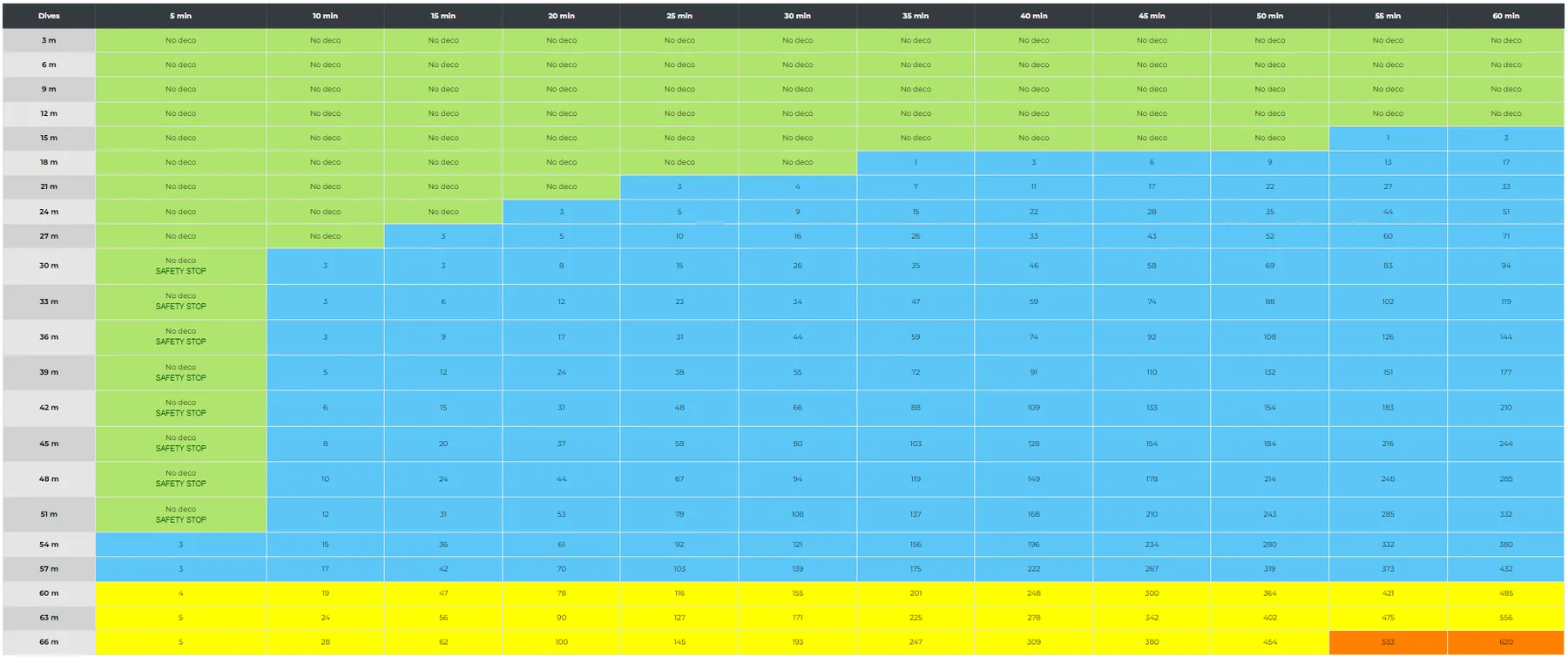
ZHL-16C uses 16 mathematical compartments with different half-times. A compartment is not a named organ. It is a calculation that represents faster or slower inert-gas uptake and elimination. During a profile, different compartments can become controlling at different times.
M-values
For each compartment, Bühlmann defined a maximum tolerated supersaturation relationship—commonly called an M-value. As ambient pressure falls during ascent, the computer limits how far the modelled tissue pressure may approach that boundary. The boundary is mathematical and does not mean bubbles cannot form below it.
Gradient factors
Gradient factors apply a percentage of the Bühlmann limit. The first number, GF Low, influences the pressure or depth at which decompression stops begin. The second, GF High, controls how close the model may approach the M-value at the surface. The computer interpolates between the two values during ascent.
Change GF Low and GF High yourself and watch how the planned ascent, GF99, NDL and decompression schedule respond. Open the BusaBoy Dive Planner →
What changing the numbers does
- A lower GF High generally reduces the allowed supersaturation on surfacing and can lengthen the shallow part of decompression.
- A very low GF Low can introduce deeper stops, but excessively deep stops may increase loading in slower compartments.
- The same pair can behave differently across profiles; it is not a universal “safety percentage.”
- Manufacturer defaults and displayed terminology should be checked in the manual.
Why transparency is useful
Because the model and gradient-factor concept are openly described, divers and researchers can compare implementations and understand why a schedule changes. Transparency supports informed planning; it does not resolve the individual variability that every decompression model must simplify.
Practical use
Use one computer consistently through the repetitive series, understand the selected gases and settings, and do not copy gradient factors from another diver without understanding the profile and rationale. Conservative ascent behaviour, adequate gas and thermal management still matter.
Continue the model series
Read RGBM in Dive Computers for the companion explanation, then Bühlmann vs RGBM for a direct practical comparison.
Sources and further reading
Explore GF Low and GF High with the Free Bühlmann ZHL-16C Dive Planner, then use the Dive Planner User Manual to interpret profiles, gas demand and decompression results. Independently verify every real dive plan.
Enjoyed this article? If you'd like to help keep the BusaBoy Archive online, you can support the archive via PayPal.