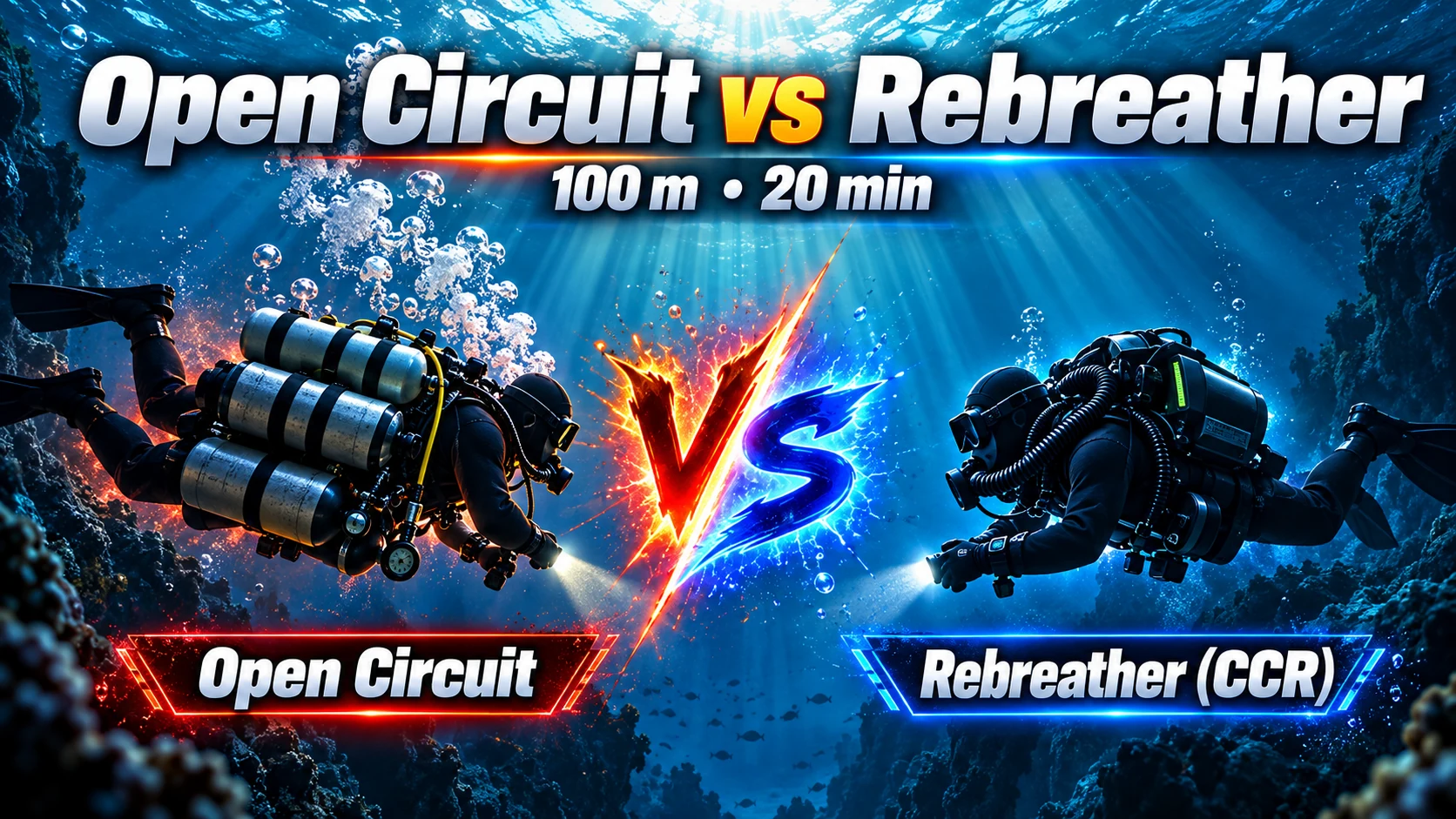
One hundred metres. Twenty minutes at the bottom. Put those two numbers into a conversation and it is tempting to ask the obvious question: is the dive better on open circuit or on a rebreather?
I think that is the wrong question. What interests me far more is what changes when the target remains the same but the breathing system changes completely. The depth is still 100 metres. The planned bottom time is still 20 minutes. The diver still has to come back through a long decompression obligation. But the route to get there, the gases carried, the workload, the failure planning and even the economics start looking like two very different dives.
I built the open-circuit example in the YouBusaBoy Dive Planner, then compared it with a CCR decompression schedule for the same maximum depth and bottom time. The numbers are interesting, but the most useful part is what they reveal about where the complexity actually lives.
The first difference appears before 100 metres
On open circuit, my bottom gas for the deep section is Tx 10/70. That is a hypoxic mix. It is not the gas I want to breathe from the surface, so the dive needs a travel strategy before I can even reach the bottom.
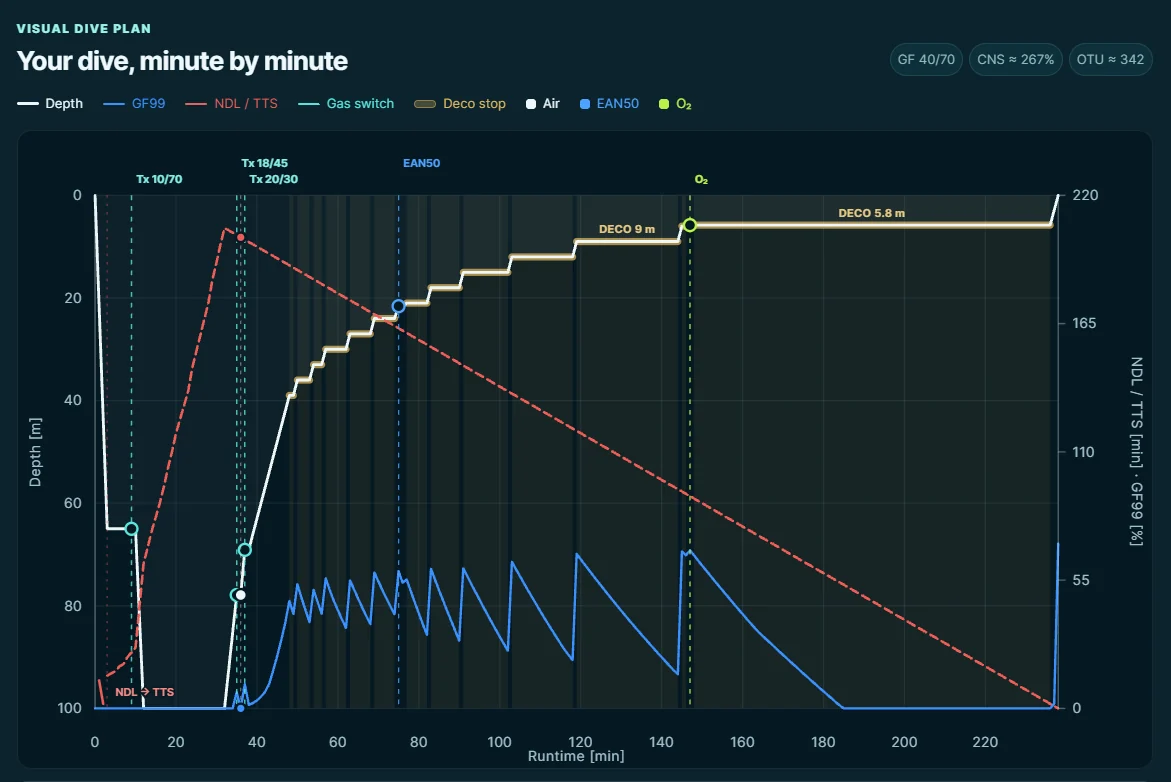
In this plan I descend on Tx 18/45 to 65 metres, spend six minutes at that level, allow a minute for the switch to Tx 10/70, then continue down to 100 metres. By the time the 20-minute bottom segment begins, the dive has already accumulated several minutes of depth exposure and one critical gas switch.
That is an important point because people sometimes compare OC and CCR by looking only at the decompression stops after the bottom. The operational difference starts on the way down. On open circuit, the gas coming out of the regulator is the breathing gas. If the deep mix is hypoxic, I need another breathable gas for the shallower part of the descent and a planned transition to the bottom mix.
On CCR the diluent is not simply inhaled and thrown away as the complete breathing mixture. Oxygen is added to the loop and the diver manages loop PO₂ through the rebreather system and setpoint strategy. With an appropriate hypoxic diluent and a properly managed variable-setpoint descent, the same travel-gas stop is not required merely because the diluent itself is hypoxic. That does not make the descent casual or automatic; it replaces one type of gas-management problem with loop management, PO₂ monitoring and rebreather procedures.
The open-circuit plan becomes a logistics exercise
After 20 minutes at 100 metres, the planner turns the dive at a runtime of 32 minutes. The ascent then involves Tx 10/70, a switch back to Tx 18/45 around 77.9 metres, Tx 20/30 around 69.1 metres, EAN50 at 21.6 metres and finally oxygen at 5.8 metres.
The total runtime returned by this particular plan is 238 minutes. The shallow end is especially striking: 25 minutes at 9 metres, followed later by an 88-minute stop at 5.8 metres on oxygen. The calculated oxygen exposure is correspondingly severe: CNS 267% and OTU 342.
But the most useful warning is not the runtime. It is the gas account. The planner calculates approximately 9,366 litres of surface-equivalent gas consumed across the five mixtures, with an estimated total gas mass consumed of about 8.70 kg.
And even that supply, as entered, is not enough. At the start of ascent the oxygen account shows a margin of -48 bar, and Tx 20/30 shows -9 bar. In other words, this is not an executable gas configuration as entered. The decompression engine can produce a pretty schedule while the gas-planning section is simultaneously telling me that I need to change the plan, the cylinders or both.
That is exactly why I like looking at the whole output rather than a single TTS number. A dive plan is not valid because the graph looks smooth.
CCR changes where the complexity lives
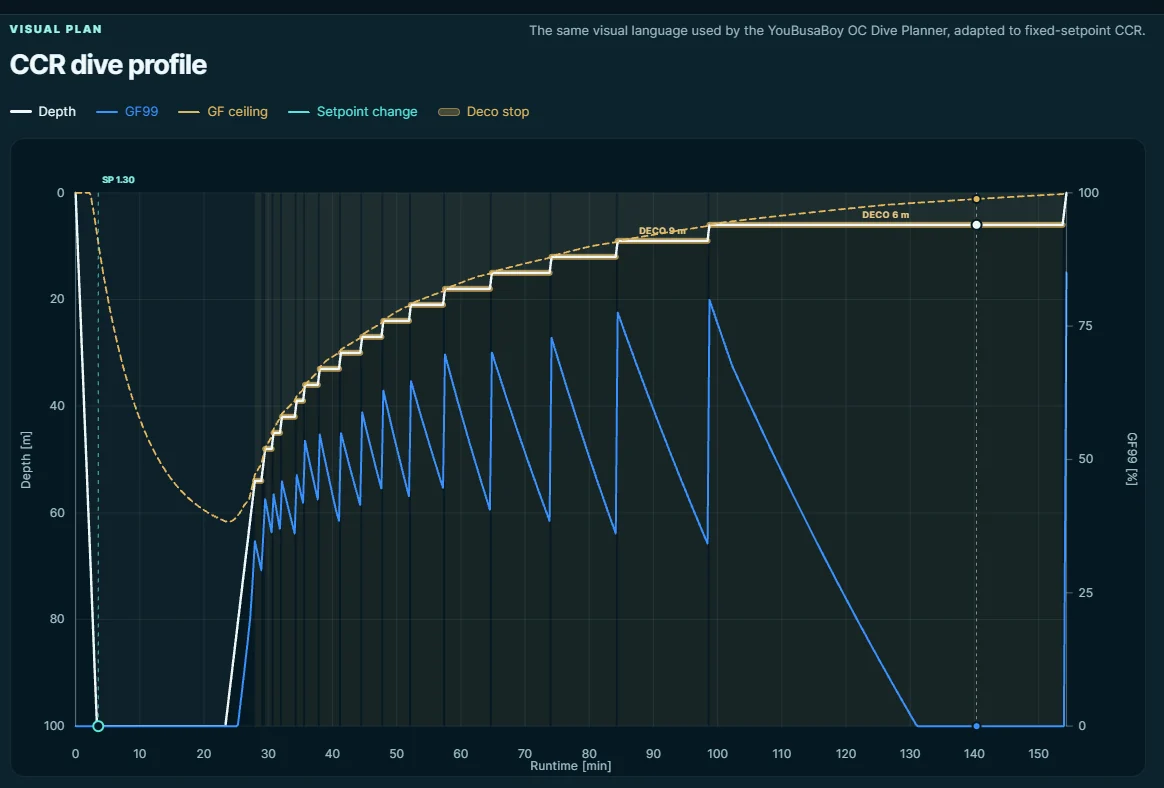
The CCR schedule I am comparing uses GF 30/85 with a working setpoint of 1.30. Its listed decompression stops total 121 minutes, beginning in the deep region and building progressively to a 55-minute stop at 6 metres.
I deliberately do not turn that into a simplistic claim that “CCR saves X minutes”. The two Gradient Factor settings are different and the open-circuit profile includes the additional travel level at 65 metres. If I wanted to isolate decompression-model behaviour, I would first have to make the profiles and settings identical.
What I can compare directly is the operational architecture. On CCR I am not moving through five breathing gases simply to optimise the normal working profile. The unit is recycling the breathing gas and controlling oxygen partial pressure in the loop. That dramatically changes normal gas consumption and removes several OC gas switches from the working dive.
But none of that means the rebreather has removed complexity. It has relocated it.
Open circuit complexity versus rebreather complexity
With OC, much of the workload is visible. There are cylinders hanging from the diver, regulators, labels, MODs, switches, pressure checks and thousands of litres of gas that must physically exist before entering the water. The cost of a mistake can be obvious: breathe the wrong gas at the wrong depth and the problem arrives very quickly.
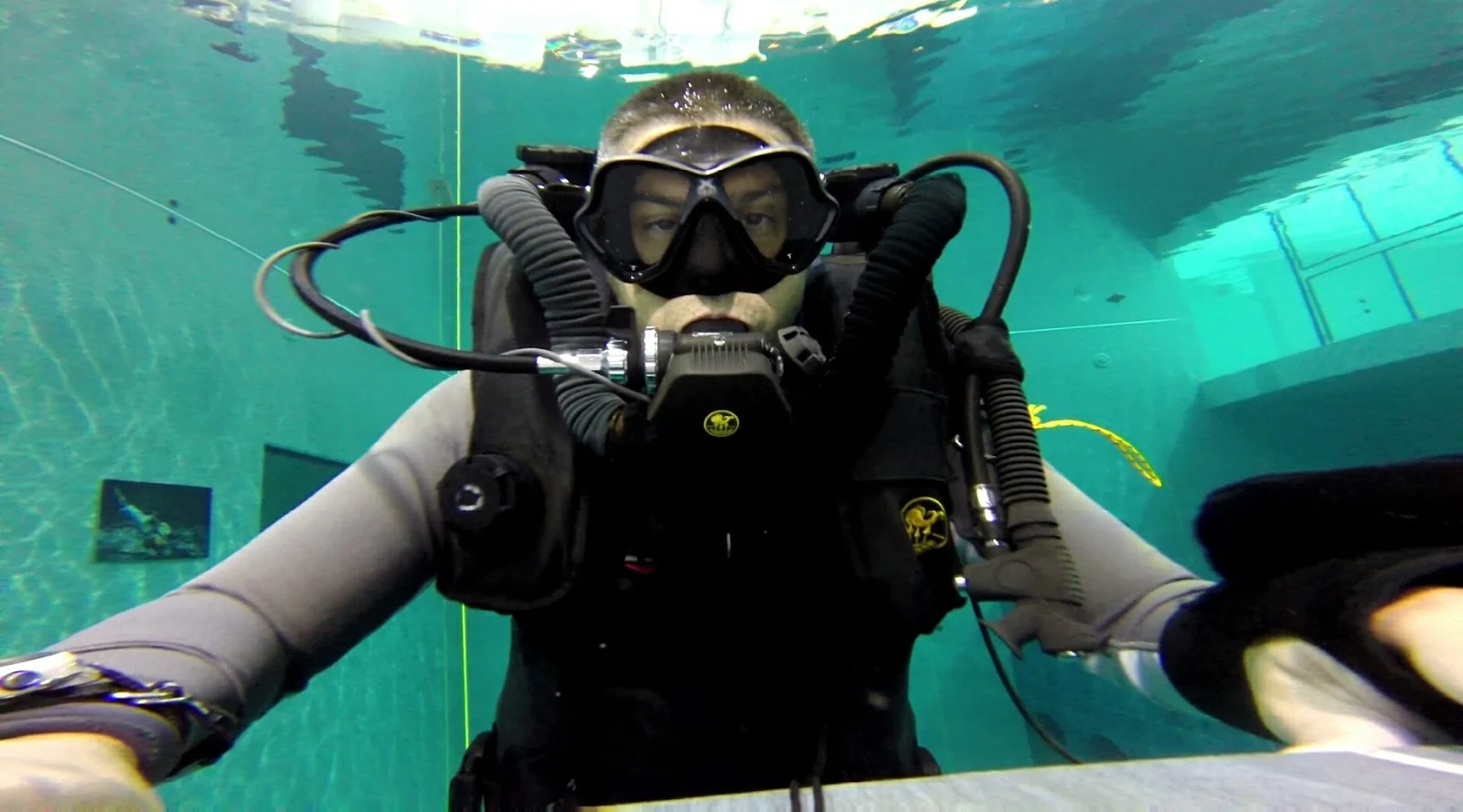
CCR hides more of the breathing process inside the machine. That is one of its strengths and also one of the reasons the training requirement is so important. The diver has to understand oxygen control, sensors, loop volume, diluent, scrubber duration, PO₂ monitoring, flooding, failures and the procedures for leaving the loop when something is wrong.
Then there is bailout. A rebreather does not make open-circuit contingency gas disappear. At 100 metres I still need a realistic way to survive a bailout and reach the surface. Depending on the team and configuration, that can still mean significant OC gas logistics. The difference is that in a normal successful CCR dive those bailout cylinders are carried as contingency rather than being steadily emptied into the sea throughout the working dive.
Then comes the uncomfortable subject: money
This is where the comparison becomes genuinely interesting.
A rebreather is expensive before it ever reaches the water. At the time of writing, TechWise Malta lists a JJ-CCR at €8,525. Its published Level 3 Trimix CCR course price is €1,600. AP Diving's European site lists its Inspiration range from roughly €7,658 before optional equipment. Add personal configuration, bailout, servicing and the rest and this is obviously not a cheap way to go diving.
But deep open-circuit trimix has the opposite financial personality. The hardware can be familiar and relatively straightforward, but every serious dive consumes a large quantity of expensive gas.
TechWise's current Malta open-circuit price page lists helium at €0.085 per litre and oxygen at €0.023 per litre, while warning that helium availability and price fluctuate. From the actual gases consumed in my planner output, this OC profile uses approximately 3,335 litres of helium and 3,193 litres of oxygen. Using those per-litre figures only as a rough benchmark, the helium and oxygen that leave the cylinders during the planned dive represent about €357.
That is not the actual invoice for the dive. Real fills include the way cylinders are blended, starting pressures, retained gas, cylinder hire where applicable, reusable remaining gas and the dive centre's charging structure. More importantly, my entered OC configuration already has negative gas margins and would need revision. The €357 figure is useful only because it demonstrates the scale of the consumable-gas problem.
Do that kind of dive once every few years and buying a CCR purely to save helium would be a strange financial argument. Do serious trimix diving frequently, and the equation changes. The rebreather has a large up-front price and continuing costs—Sofnolime, oxygen cells, oxygen, diluent, servicing and bailout—but helium is no longer being breathed once and released into the water at the same rate throughout the dive.
A rebreather is expensive when you buy it. Trimix is expensive every time you breathe it.
Training belongs in the cost comparison too
It is easy to compare a CCR purchase price with the gas bill and forget training. That would be misleading in both directions.
Moving from OC into CCR means unit-specific training and then additional progression for deeper mixed-gas diving. That takes time, money and real practice. But a diver does not simply decide to do a 100-metre hypoxic trimix dive on open circuit either. Advanced OC trimix training is itself substantial; for example, TechWise currently lists its TDI Advanced Trimix course as the 100-metre-level OC programme.
So the honest economic comparison depends on where the diver is starting. For somebody already fully trained and equipped for OC hypoxic trimix, CCR training and equipment are genuinely additional investment. For a diver choosing a long-term path from much earlier in technical training, both routes involve major education and equipment costs.
If money were no object…
There is one personal detail I should probably admit after spending an entire article comparing open circuit and CCR.
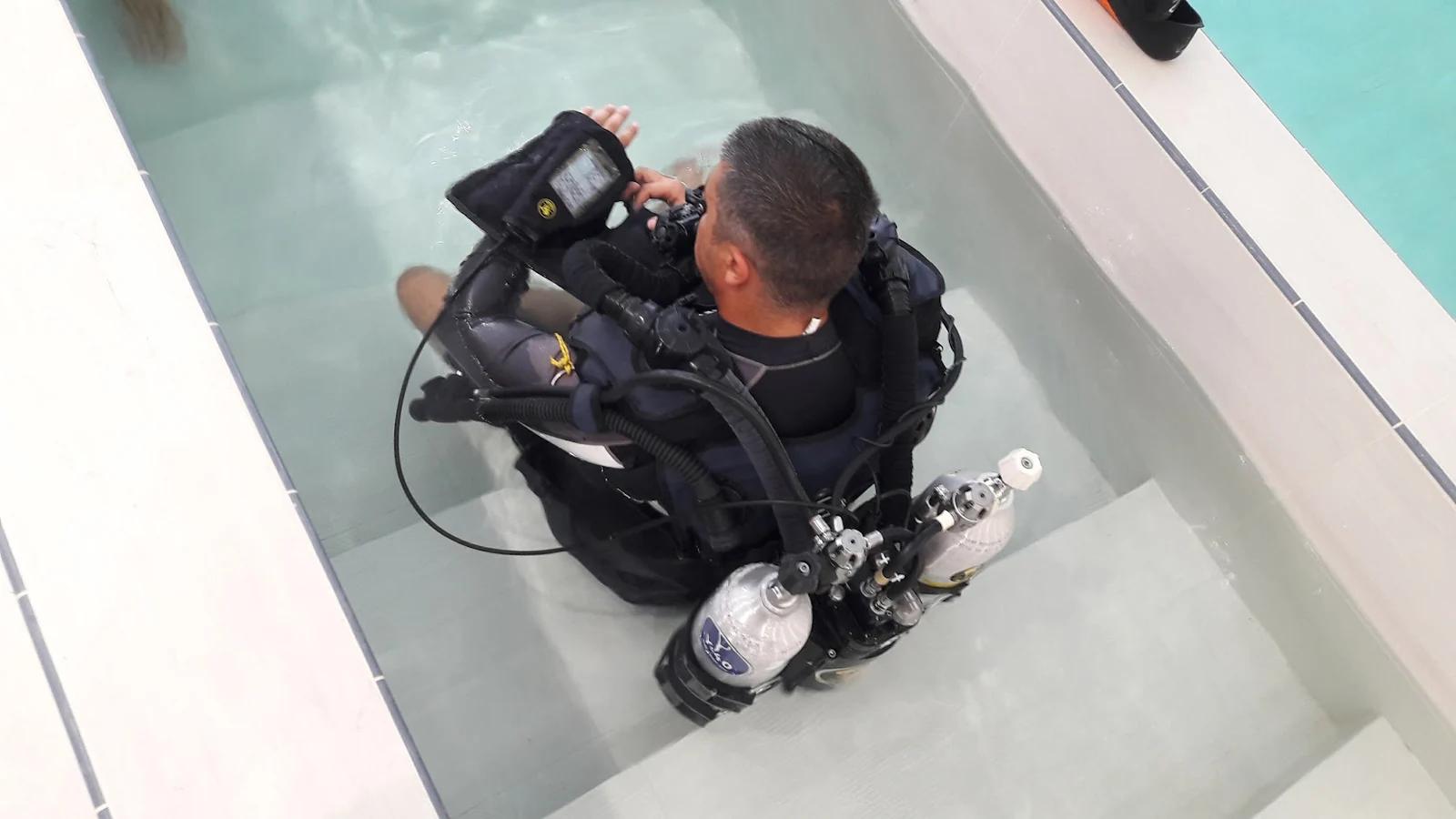
If I had the money, one of my dream pieces of diving equipment would be a sidemount rebreather.
And I do not mean taking a conventional back-mounted rebreather and finding some clever way to attach it to a sidemount BCD. What appeals to me is a machine designed from the beginning to live where a sidemount cylinder normally lives. Something like the Divesoft Liberty Sidemount Rebreather is exactly the concept I mean.
That makes sense to me because sidemount is already the configuration I naturally enjoy. I like the freedom, the modularity and the ability to build the equipment around the dive rather than forcing every dive into the same configuration. A purpose-built sidemount CCR takes that philosophy in a very interesting direction: instead of adding a large machine to my back, the rebreather becomes part of the lateral system itself.
Would I like one? Absolutely. Would I actually need one for most of my diving? That is where the answer changes.
Malta changes the calculation
The 100-metre comparison in this article is useful precisely because it pushes both systems into a part of diving where helium consumption, hypoxic gases, bailout and decompression become major planning problems. But most of the dives I actually enjoy in Malta are nowhere near 100 metres.
Take the Um El Faroud. On the routes I normally consider, even going down around the propeller area puts the dive at roughly 36 metres. That can still be a serious and extremely enjoyable technical-style dive, but it is a completely different problem from the 100-metre example above.
For that kind of diving, a couple of cylinders of air and, when the plan justifies it, a stage cylinder can give me an enormous amount of underwater time and flexibility. I can use equipment I already know, already own and already maintain. There is no rebreather purchase, no scrubber material, no oxygen-cell replacement schedule and no need to turn every normal wreck dive into a CCR-preparation exercise.
That does not make the sidemount Liberty any less desirable to me. It simply separates dream equipment from necessary equipment.
At 80, 90 or 100 metres, especially when helium enters the equation, a CCR can solve very real logistical and economic problems. At 30–36 metres in Malta, the equation can be completely different. Sometimes two familiar cylinders and one useful stage are already enough to have a fantastic dive without breaking the bank.
That is probably the most important equipment lesson hidden inside this entire comparison: choose the dive first, then choose the technology. Not the other way around.
So which one is easier?
Neither, once the dive becomes serious enough.
Open circuit is mechanically simple and brutally transparent. Gas is available or it is not. Every breath reduces the pressure in a cylinder and every gas switch is a deliberate physical action. At 100 metres, however, that simplicity creates enormous gas demand and a surprisingly complicated logistical chain.
CCR is extraordinarily efficient with breathing gas and can make the descent and normal working profile much cleaner, particularly when hypoxic diluent and setpoint management replace the need for the same OC travel-gas sequence. But that efficiency comes from putting a sophisticated life-support system between the diver and the surrounding water.
The question is therefore not really, “Which system is simpler?”
It is: which type of complexity are you trained, equipped and prepared to manage?
What this 100-metre example taught me
The headline sounds like a contest: Open Circuit vs Rebreather. In reality, the interesting result is not a winner. It is how quickly the same 100-metre, 20-minute target turns into two very different planning problems.
On OC, the problem becomes travel gas, hypoxic bottom gas, switches, cylinder capacity, reserves, decompression gases and the cost of throwing helium away with every exhalation. On CCR, the breathing-gas efficiency is dramatically better, but the diver takes responsibility for loop chemistry, PO₂ control, scrubber performance, machine failures and a bailout plan capable of bringing the dive back into the open-circuit world if necessary.
For me, that is the useful lesson. Technology does not remove the difficult part of technical diving. It changes where the difficult part lives.
And at 100 metres, understanding that difference matters far more than choosing a side in a “VS” picture.
Sources and price references
The planning figures in this article come from the two example profiles described above. Current price references checked on 26 September 2026: TechWise Malta Open Circuit Prices, TechWise Malta Closed Circuit Prices, JJ-CCR listing and the AP Diving Europe Inspiration configurator. Gas and equipment prices change; check current local prices before using any cost comparison.